No country is immune from water scarcity issues—not even wealthy countries like the United States.
Population growth and climate change are stretching America’s water supplies to the limit, and tapping new sources is becoming more difficult each year—in some cases, even impossible.
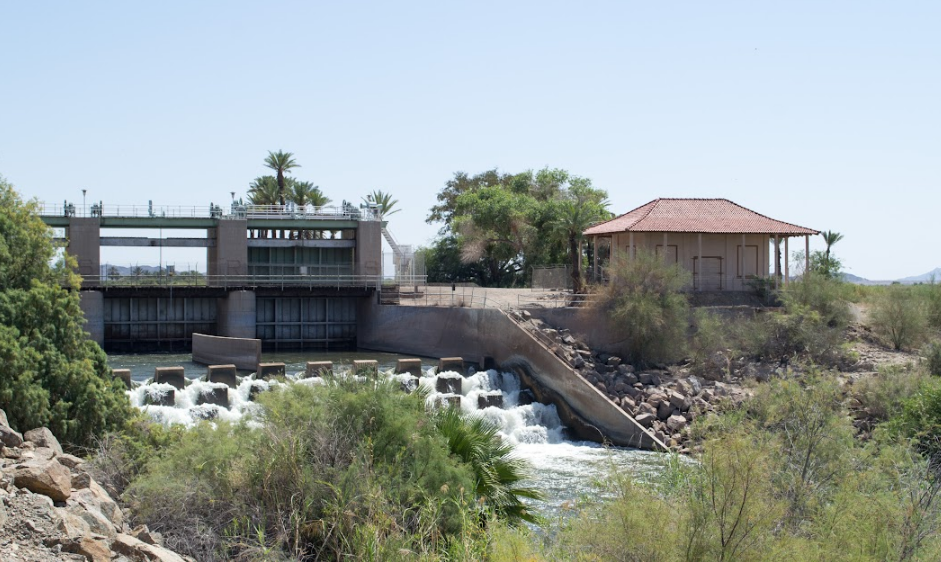
The Southwestern states, in particular, have faced “intense” droughts during the 21st century, and traditional water supplies are failing. As groundwater supplies in the region have depleted substantially, rainfall has decreased, and water import costs have risen substantially. According to a September 2022 Nature article about the water situation in the Southwest, there is a “very low chance for regional mega-reservoirs to regain full-capacity levels assuming current demand.”
The region looks to the Colorado River as its plumbing system, which currently provides drinking water to 1 in 10 Americans—all while irrigating nearly 5.5 million acres of land. But it’s also being stretched to its limits: Population growth and expansive development are increasing agricultural demands. Meanwhile, the pressure to ensure sufficient water is left in the environment to support ecosystems has accelerated. According to a December 2012 study by the U.S. Department of the Interior Bureau of Reclamation, the demands on the Colorado River are expected to exceed supply by 2040.
On top of this, each state has vastly different needs. For example, Nevada’s needs are largely urban, but Arizona and California require water for huge agricultural and urban sectors. Each year, states argue over who has the superior right to water supplies. And once they have their allocation, districts frequently end up in litigation over their allotment. There is always a shortage of water, raising questions about who is responsible and how best to mitigate the water crisis.
In 2023, the depleting water levels in the river created a “crisis after decades of overuse.” The seven states that depend on the Colorado River for water and power had to agree to reduce their water usage to ensure the river was still flowing. “Three states—Arizona, California, and Nevada—have agreed on a plan to conserve at least 3 million acre-feet of water by 2026—roughly the equivalent to the amount of water it would take to fill 6 million Olympic-sized swimming pools,” reported NBC in May 2023.
While demand is increasing, climate change has damaged supply—and the impact is twofold: As less water comes down the Colorado River, people are using more water due to increased temperatures.
Simply put, there is only so much water.
“When you can’t make the pie bigger, and you’re fighting over a finite supply, it’s a misery index, just an allocation pain for all parties,” says Brad Herrema, a lawyer specializing in water law and natural resources.
“But if you can make the pie bigger, there’s less fighting.”
Turning Wastewater Into a Resource
Our existing water supplies must be expanded, and the technology exists to do this by turning wastewater into drinking water. This is not a new science, but the practice has evolved significantly in the past 50 years.
In the 1960s, water availability became problematic in rapidly growing areas in the U.S., and water managers began to consider using wastewater to augment supplies. Several water reuse projects were built in the following decades in California, Virginia, Texas, and Georgia, but larger developments in the 1990s were met with opposition. “Toilet to tap” narratives in the media fed misperceptions regarding the treatment process, which helped to dismantle public support for these projects. What “toilet to tap” misses is membrane filtration, as of 2024, is membrane desalination, ozone, and advanced oxidation, to name a few treatment options that make the purified water entirely safe to drink.
However, advances in these technologies associated with water reuse helped boost confidence in and acceptance of the practice among water professionals in the early 2000s. Now, water reuse is entering the mainstream.
Almost half of all the potable reuse projects built in California since the first in 1962 were installed between 2009 and 2023, with several more on the horizon. With more potable reuse projects than any other state, California plans to use 2.5 million acre-feet of water per year (AFY) by 2030.
According to a document by the Environmental Protection Agency and CDM Smith Inc., potable reuse also makes up “a significant portion” of the nation’s water supply once de facto reuse is factored in.
What’s clear is that some major U.S. cities are already delivering recycled wastewater to consumers on a massive scale and expanding the pie. However, how a municipality can recycle wastewater depends largely on the area’s geography, financial resources, and, perhaps most importantly, the public’s attitude.
Las Vegas
Las Vegas recycles nearly all of its water used indoors, giving it a virtually inexhaustible supply of water for domestic consumption. The city benefits from its unique geography. Almost 90 percent of southern Nevada’s water is taken from Lake Mead, which lies on the Colorado River. It is then treated and run through the city’s system. After it’s flushed or drained, the water makes its way to a wastewater treatment plant before it’s discharged into the Las Vegas Wash. From there it makes its way to Lake Mead where it is either drawn back out or stays in the river, ensuring there’s enough water for cities downstream of Vegas.
One key element that makes Vegas’s reuse system so effective is “the Wash,” a 12-mile-long channel that acts “as the ‘natural kidneys,’ cleaning the water that runs through them by filtering out [any] harmful contaminants” on its way back to Lake Mead. Thanks to the Wash, when the water is withdrawn again, it does not need to undergo a costly process of advanced treatment; instead, it undergoes basic drinking water treatment.
Another critical factor in Vegas’s success is that for every gallon of water the city puts into Lake Mead, it can take a gallon back out—meaning the city is essentially recycling its indoor water in a closed loop. This is known as de facto water reuse.
Nevada is allocated 300,000 AFY of water from the Colorado River each year. Bronson Mack, public information officer with the SNWA, says that in 2019, the city actually diverted 490,000 AFY of water from the Colorado River but only consumed 234,000 AFY. About 256,000 AFY was returned to the lake.
“Our return flow credits system is unique,” says Colby Pellegrino, deputy general manager of resources for SNWA. “Once we return the water to Lake Mead, we’re not charged for that water. We’re only charged for the total we depleted.”
Mack adds that local water utilities were paying $313 for treatment and delivery of 1 acre-foot of water as of 2020, and passing that cost on to the consumer. If Vegas could not return such a large proportion of its water, that cost would rise dramatically.
De facto reuse is also vital for a city that can’t afford to gamble on the weather—Las Vegas is the driest city in the U.S. When the Colorado River produced only 25 percent of its usual supply in 2002, the city was struck by drought, but its citizens still had unlimited access to indoor water.
“Vegas couldn’t exist without [the] return flow credits approach,” says Daniel Gerrity, principal research scientist at SNWA. “Without that, we’d have already maxed out.”
Despite a wet winter in 2023 and an improvement in the water levels in lakes, “Southern Nevada’s water supplies from the Colorado River at Lake Mead remain under shortage reductions,” points out Southern Nevada Water Authority, warning that “The risk of shortage remains high in future years.”
Meanwhile, not every city has a Lake Mead or a Wash. For places without Vegas’s luck, there are other ways to ensure water reuse.
Orange County, California
Orange County Water District (OCWD) is a world leader in water reuse. Since 2008, it has provided drinking water to 2.5 million people—in a region with no more than 15 inches of annual rainfall—through its Groundwater Replenishment System (GWRS) project. This project has helped highlight the effectiveness of IPR, giving other providers a model to emulate and providing the full-scale data that was previously missing to evaluate the viability of the process.
The water reused through GWRS would have otherwise been discharged into the Pacific Ocean. By keeping it in the system, there is less reliance on the Colorado River, easing the strain on its supplies.
The city utilizes a process called indirect potable reuse (IPR). In the absence of an environmental filtration process like the Las Vegas Wash, Orange County’s wastewater has to undergo advanced treatment before it is pumped to a groundwater basin. From there, it is pumped to the consumer via a standard drinking water treatment train, making it safe to consume and completing the cycle. The process not only turns wastewater back into a resource but also saves massively on the cost of pumping Colorado River water from hundreds of miles away.
GWRS, which is a joint project of OCWD and the Orange County Sanitation District (OCSD) “accounts for approximately 35 percent of water demands,” according to OCWD, and its wastewater treatment capacity was further expanded in 2023 from 100 to 130 million gallons per day. This is “enough to fill nearly 200 Olympic-sized pools and enough for a million people,” according to a 2023 article by the Daily Pilot.
“Orange County is the benchmark [for] water reuse system,” says Gerrity. Water managers from around the world visit OCWD to learn how they’ve managed such success.
Like so many regions innovating in water reuse, drought forced their hand. In 1975, “[a]s imported water supplies became less available, another source of water was needed to fight seawater intrusion. In April 1975, OCWD unveiled… [a facility that] took treated wastewater from the… OCSD, blended it with deep well water and injected it into… [a basin]. In 1977, [OCWD became]… the first in the world to use reverse osmosis to purify wastewater to drinking water standards.”
The project was expanded in line with the demand in the ’90s, and the GWRS, which has been operational since 2008, is now the world’s largest advanced water purification system for potable use. “The largest reuse facility in the world can now treat nearly 500 million liters of secondary wastewater a day,” points out the nonprofit Water Reuse Europe.
And through it all, OCWD managed to swerve the “toilet to tap” attacks that had ruined public support for such projects in other areas of California.
How?
“People expect to find out that our success is grounded in some secret technology, but they find out it’s all about education, education, education,” says Rob Thompson, general manager at OCSD, which treats the water before sending it to the basin managed by OCWD. “Bringing the public on board with drinking [recycled] wastewater takes a lot of outreach. Getting over the ‘yuck factor’ is everything. We had to speak with NGOs, governors, the authorities, politicians—you name it—we spoke to them. Once you have enough people on board, everyone starts to think it must be okay.”
“People have high expectations about the quality of their water and have a lot of questions,” adds Megan Plumlee, who heads OCWD’s research and development department. “We explain to the public what we’re doing and how it’ll benefit the district, retailers, and community.”
Following OCWD’s lead, San Diego embarked on a massive multi-year potable reuse project that planners say will provide nearly 50 percent of the city’s water supply locally by the end of 2035. Indeed, sometimes a new process takes hold only because of a leader in the field who shows the way and proves something can be done safely on a large scale.
“We weren’t the first to try it, but we were the first to succeed on such a massive scale. That’s because we were the first to really embrace education. Now others are doing the same,” says Thompson.
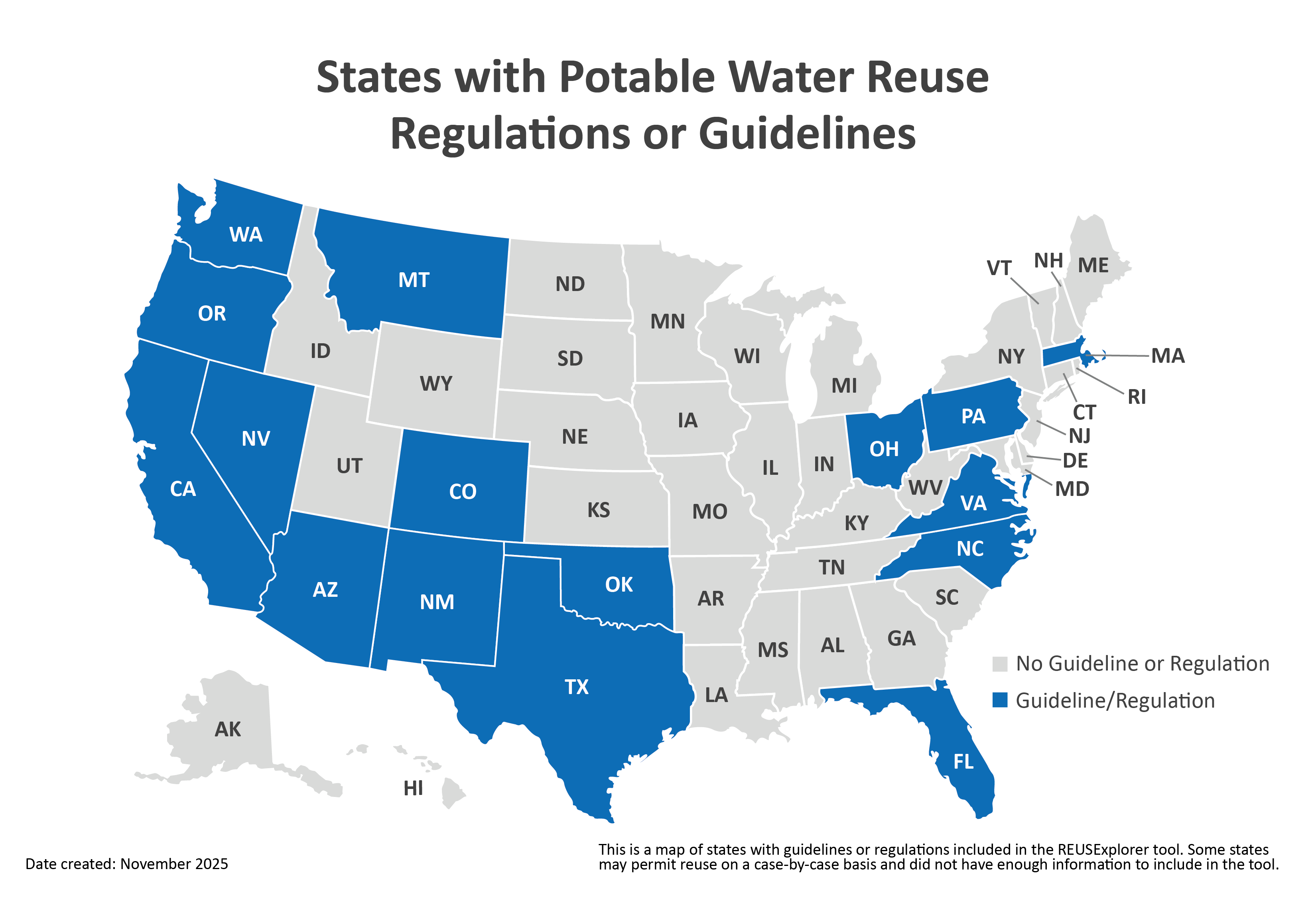
Now, 16 states have developed regulations that allow for IPR, with several more IPR projects on the horizon that will help bolster water supplies—all without putting additional pressure on the Colorado River.
Another more efficient water reuse method has yet to take hold in the U.S., though it may soon find its leader.
San Diego
Direct potable reuse (DPR) was labeled the final frontier of water reuse by G. Tracy Mehan, the executive director for government affairs at the American Water Works Association (AWWA), in a November 2019 Opinion piece published in the Scientific American. The process does away with an environmental buffer and pumps wastewater directly through an advanced treatment train before it is purified and put straight back into the system in a matter of hours.
Given this reality, DPR can deliver water more efficiently and cost-effectively by using existing infrastructure and without needing to build expensive and energy-intensive pipelines to a reservoir or groundwater basin. DPR can also allow for more water to be recycled than IPR as there are no limitations on the reservoir or groundwater basin.
Additionally, DPR avoids regulations on putting water back into the environment by eliminating the buffer. And finally, DPR can be more reliable and efficient. Jeff Mosher, vice president and principal technologist at Carollo Engineers, a leading firm in engineering water reuse systems, explains that DPR can turn wastewater into drinking water in a matter of hours, faster than IPR or any other reuse method.
As of early 2023, only one facility in the U.S. is currently equipped to operate DPR. Big Spring in West Texas identified DPR as the most feasible way to address an urgent need to diversify the city’s water portfolio and increase its supply reliability for when rains fail to fill the city’s reservoirs—the project serves around 135,000 people, according to a 2019 article published in the Journal of Environmental Planning and Management.
The Colorado River Municipal Water District (CRMWD) in Big Spring began operating this plant in 2013. It could treat up to 2 million gallons per day of wastewater effluent to drinking water standards, providing a much-needed water supply amid punishing droughts.
However, DPR has yet to become a mainstream and trusted water supply system, and it remains unused beyond times of crisis and for larger communities.
Arizona and Florida are in the process of developing their DPR regulations while California and Colorado already have these regulations in place. However, most states have yet to consider implementing this technology, mainly due to a lack of public acceptance. The speed at which DPR recycles wastewater makes it particularly vulnerable to “toilet to tap” attacks, and this has consumers concerned, who worry over the small room for error and the “yuck factor.”
An attempt to introduce potable reuse in San Diego in the 1990s failed after fears of “drinking sewage” diminished trust in the project and fostered uncertainty about the safety of the water. Fast-forward 12 years to 2011, a rebranded project, Pure Water San Diego, did things differently.
A 2012 survey carried out by the San Diego County Water Authority found that 73 percent of the respondents either strongly or somewhat favored “advanced treated recycled water as an addition to the supply of drinking water.” This figure was an improvement from the 2011 survey.
San Diego has changed its mind, and now it may one day do what OCWD has done for IPR and pave the way for DPR use on a broader scale.
With lessons learned from OCWD, outreach helped bring the community on board in San Diego. “We had to educate the community on the concept [of potable reuse],” Amy Dorman, assistant director at San Diego’s Pure Water program, says. “We ran focus groups with the community, made ourselves flexible moving forward, and recognized the importance of listening to the community. In the ’90s, there was not the right amount of education. Now it’s comprehensive. We do tours, presentations, websites, mailers and [identify] all stakeholders—[ensuring] diligent and constant outreach.”
Dorman explains that 18,665 San Diegans have visited the demonstration facility as of 2021, while the team at Pure Water has spoken to almost 30,000 children in schools. They explain that 50,000 lab tests have been carried out on the water supply as of 2020, each meeting every regulatory standard and producing exceptional water quality—typical tap water is actually less highly treated than DPR tap water.
However, the key statistic is that 85 to 90 percent of San Diego’s water is already imported from the Colorado River and Northern California Bay-Delta. In fact, because the city is downstream, Dorman says the water has already been recycled 49 times by other water districts before reaching San Diego. She says this usually quells fears that drinking recycled water is unsanitary since, as it turns out, this has been happening for years.
“What we know now is that it’s possible to convince people,” adds Mosher. “We have proven that every community you go into that has concerns, you can overcome.”
San Diego hopes that by 2035, a third of the city’s water supply will come from locally supplied, recycled wastewater instead of importing the majority of it.
For phase one, the Pure Water San Diego program—funded by the San Diego government—will use IPR to provide the city with 30 million gallons of water per day, utilizing the nearby Miramar Reservoir as an environmental buffer in a similar way to how Orange County uses its groundwater basin. “San Diego’s Pure Water treatment system will be operational and providing 7 million gallons of water a day to residents by 2026,” says a January 2024 KPBS article.
Phases two and three will target an additional 53 million gallons of water per day by 2035. In the absence of a groundwater basin and large enough reservoirs, Pure Water San Diego plans to employ DPR to realize the project’s full scale.
Mosher says that cities with plans to do DPR one day don’t want the attention to be the ones to take the plunge into doing it on a large scale. But with projects on the horizon in San Diego and El Paso, Texas, Mosher expects greater faith in the process by 2030. A 2011 public opinion poll shows that citizens are 50 percent more likely to accept recycled water when they learn that other communities have done so already.
Without a leader in the field, cities interested in doing DPR may hesitate, but Gerrity is positive about the impact San Diego can have countrywide.
“It’s a good platform to go forward,” he says. “We have more options for facing water scarcity, another tool in the toolbox to tap into. Conservation, potable reuse [and] innovative technologies all extend supply and give high-quality drinking water to the public.”
Mainstreaming Potable Reuse
While water reuse is breaking into the mainstream, there are still challenges going forward.
It is not simply a matter of copying Las Vegas, Orange County, or San Diego. A region’s geography and finances often dictate a city’s water supply, which significantly impacts what kind of reuse that city can attempt. De facto reuse, as in Las Vegas, is incredibly site-specific and requires the geography of an area to substitute for advanced treatment, while the most successful IPR projects rely on large groundwater basins and nearby reservoirs.
Both types of potable reuse are also incredibly expensive. While they may save money in the long term, they require a huge initial investment.
The federal government needs to step in to support water recycling projects. Taking a step in this direction, the Biden administration provided almost $100 million for the Pure Water Southern California facility. “Water recycling is an innovative and cost-effective tool that can help make our water supplies more reliable, helping communities find new sources to meet their needs today, but most importantly to meet our needs in the future,” said Reclamation Commissioner Camille Calimlim Touton in May 2024.
Working out what works best for one community is half the battle. Thanks to the geographical nuances that help potable reuse or de facto reuse work, there is no one-size-fits-all.
“You could take what Orange County does, and it’s going to work, but the question is whether that is the best approach for that location. So, the challenge is, now that we feel comfortable with one approach, can we do it a different way?” says Gerrity.
Mosher is trying to compile all the information on water reuse into an easy-to-read guidance document that cities considering the process can use to decide which approach may be best for them.
“It’s about getting to a point where communities who want to try DPR don’t feel overwhelmed,” says Mosher.
What’s clear is that the Colorado River can no longer be relied upon to meet the water needs of an increasing population. If we continue asking so much of it, we have to start easing those pressures. Water reuse is imperative if the driest parts of the world continue growing without destroying the environment that relies as much on water as we do.
Freddie Clayton is a journalist who splits his time between Valencia, Spain, and London, England. He has written for the Economist, Americas Quarterly, and the Daily Telegraph. He is a member of the Solutions Journalism Network and a contributor to the Observatory. Find him on Twitter @FrederickJC1.
This article first appeared on Truthout and was produced in partnership with Earth | Food | Life, a project of the Independent Media Institute. It was supported by the Solutions Journalism Network and received editorial support from the Center for Collaborative Investigative Journalism.