


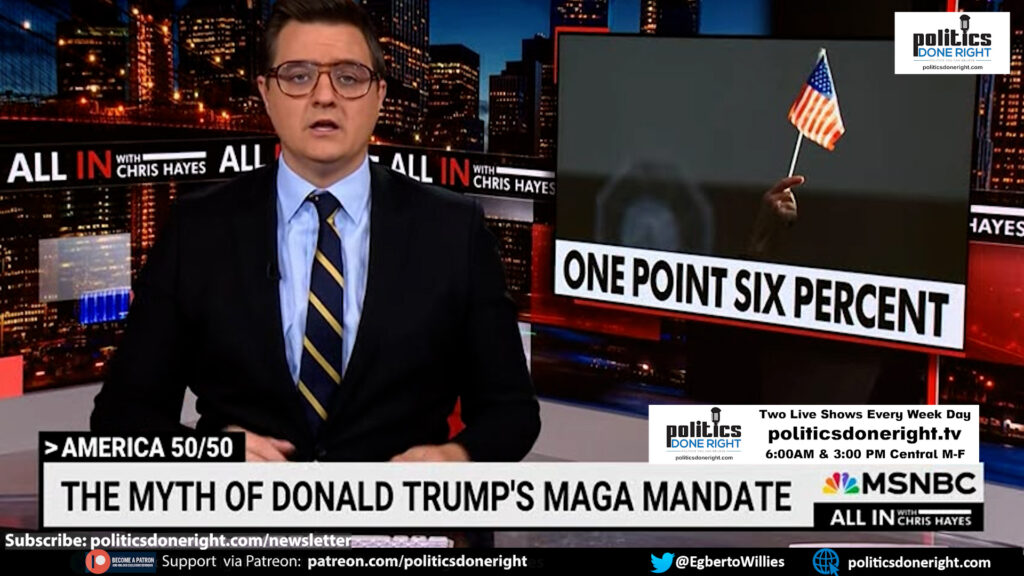
When one examines the data, one sees that Trump had one of the weakest victories. He had no mandate. He did not even win 50% of the popular vote and won by just 1.6%.
Don’t fall for the Trump mandate con.


Podcasts (Video — Audio)
Summary
The video critiques Donald Trump’s narrow electoral victory and the false narrative of a sweeping mandate being used to justify extreme policies. It highlights the contradictions between his slim win and his overreaching agenda, compares it to past elections with true mandates, and underscores the importance of addressing systemic flaws in the U.S. electoral system. It calls for vigilance against authoritarian policies while emphasizing the need for progressive action to protect democracy and align governance with the majority’s will.
- Smallest Popular Vote Margin: Trump’s popular vote margin was historically small (1.6%) and far less decisive than Obama’s or Biden’s wins.
- No Down-Ballot Coattails: Democrats outperformed expectations in down-ballot races, flipping Senate seats in swing states Trump won.
- False Narrative of a Mandate: Despite narrow margins, Trump and his allies falsely frame the election as a transformative victory.
- Authoritarian Overreach: Trump’s agenda includes extreme policies like ending birthright citizenship, weaponizing the DOJ, and targeting marginalized communities.
- Progressive Response Needed: The left must challenge the Electoral College, counter disinformation, and advance a pro-democracy agenda.
Donald Trump’s narrow victory, built on a flawed and undemocratic electoral system, is being exaggerated into a false mandate to justify authoritarian and regressive policies. This overreach, detached from the actual will of the people, underscores the urgent need for progressives to champion electoral reforms, protect vulnerable communities, and counter the dangerous narrative of a MAGA transformation. The fight for democracy and justice cannot wait.
[ppp_patron_only level=2]
The narrative surrounding Donald Trump’s electoral victories is often more fiction than fact. Following his popular vote loss and narrow Electoral College win in 2016 and another slim margin of victory later, Trump and his supporters attempted to paint these outcomes as sweeping mandates, signaling overwhelming public support for his agenda. This is far from the truth. Trump’s victories, particularly in the Electoral College, represent the fragility and undemocratic nature of the U.S. electoral system, not a seismic shift in the will of the people. It is critical to dismantle this myth and confront the dangers of allowing such rhetoric to shape public policy.
The Electoral College and the Mirage of Mandates
In 2016, Donald Trump lost the popular vote by nearly three million but secured the presidency through the Electoral College, an institution that disproportionately empowers less populous states. This time, the numbers are even narrower. Trump’s popular vote margin was just 1.6%—one of the smallest in U.S. history. Trump’s win was barely a ripple compared to the decisive victories of Barack Obama in 2008 and Joe Biden in 2020.
What makes Trump’s claim of a mandate even more audacious is the context of Democratic performance in down-ballot races. Despite the challenging landscape, Democrats secured Senate victories in key swing states like Michigan, Wisconsin, Nevada, and Arizona—states Trump carried. This underscores that voters were not aligned with Trump’s extreme MAGA agenda but made complex, localized decisions based on candidate quality and policies. More importantly, a win by such a defective candidate against one as competent and moral as VP Kamala Harris makes it clear America has not cured its metastasized cancers, racism, sexism, and misogyny.
The Media’s Role in Inflating the Myth
One troubling aspect of this narrative is how the mainstream media has sometimes reinforced it. By failing to highlight the razor-thin nature of Trump’s victories and contrasting them with his policy overreach, the media has enabled the illusion of a broad mandate. For instance, when Hillary Clinton won the popular vote in 2016 but lost the Electoral College, the media focused heavily on her perceived failures with white working-class voters. In contrast, Trump’s historically narrow popular vote win receives far less scrutiny regarding what it says about his support base.
This double standard contributes to the myth of Trump as a populist hero who swept the nation with a transformative vision. His victories represent small shifts among late-deciding voters driven by a facade of dissatisfaction with the economy to mask racial and gender prejudices. These shifts are not a wholesale endorsement of Trump’s radical policies.
Trump’s Overreach: Governing Without Consent
Trump’s policy agenda starkly contrasts the will of most Americans. From threats to revoke birthright citizenship, a right enshrined in the 14th Amendment, to plans to militarize immigration enforcement, Trump’s proposals represent an authoritarian vision far removed from the needs of everyday voters. Most Americans want affordable healthcare, economic stability, and functional governance—not the chaos and divisiveness that have become Trump’s trademarks.
Kamala Harris was correct in characterizing Trump’s agenda as one rooted in vendettas rather than governance. His administration’s plans, outlined in the “Project 2025” framework, focus on dismantling regulatory protections, targeting marginalized communities, and consolidating power within a small, ideologically driven circle. None of this reflects the desires of the electorate, who did not vote for a wholesale dismantling of democratic norms.
Progressives Must Challenge the Narrative
Progressives have a vital role in exposing the con behind Trump’s self-proclaimed mandate. This starts with articulating a clear vision addressing voter dissatisfaction’s root causes. It also requires relentless fact-checking and narrative-building to counteract Trump’s propaganda machine.
The left must also champion reforms to democratize the electoral process. Abolishing the Electoral College, implementing ranked-choice voting, and expanding voter access are necessary to ensure that the majority’s will is reflected in election outcomes. Without these reforms, the U.S. risks continued governance by a minority, further eroding trust in democratic institutions.
Conclusion: A Reckoning Awaits
While legitimate within the existing system, Trump’s victories do not signify a mandate. They are the product of an outdated and unequal electoral structure coupled with misinformation and strategic voter targeting. As Trump and the Republican Party push forward with an agenda detached from the needs of most Americans, the disconnect will become increasingly evident.
Progressives must seize this moment to highlight the disparity between Trump’s narrow victories and his sweeping overreach. By doing so, they can lay the groundwork for a more equitable and democratic future—one that reflects the true will of the people, not the manipulations of a system rigged for the few.
[/ppp_patron_only]