Author, journalist, and child advocacy expert Richard Louv famously coined the term “nature deficit disorder” to describe the detrimental effects of children’s disconnection from nature. His assertions are backed by data that strongly suggests a link between increased exposure to nature and improved cognitive function, brain activity, and mental and physical health.
Paraphrasing Louv, nature schoolteacher Angela Garcia notes, “America is completely deficient in Vitamin N: Vitamin Nature.”
Garcia is the co-director of True Roots Nature School Program, a Santa Cruz, California-based outdoor education curriculum for children ages 18 months to 12 years old. Designed to provide all the benefits of indoor education while enriching the experience with nature immersion, this program “takes place on private property in the Santa Cruz Mountains in addition to field trip locations,” the school’s website states.
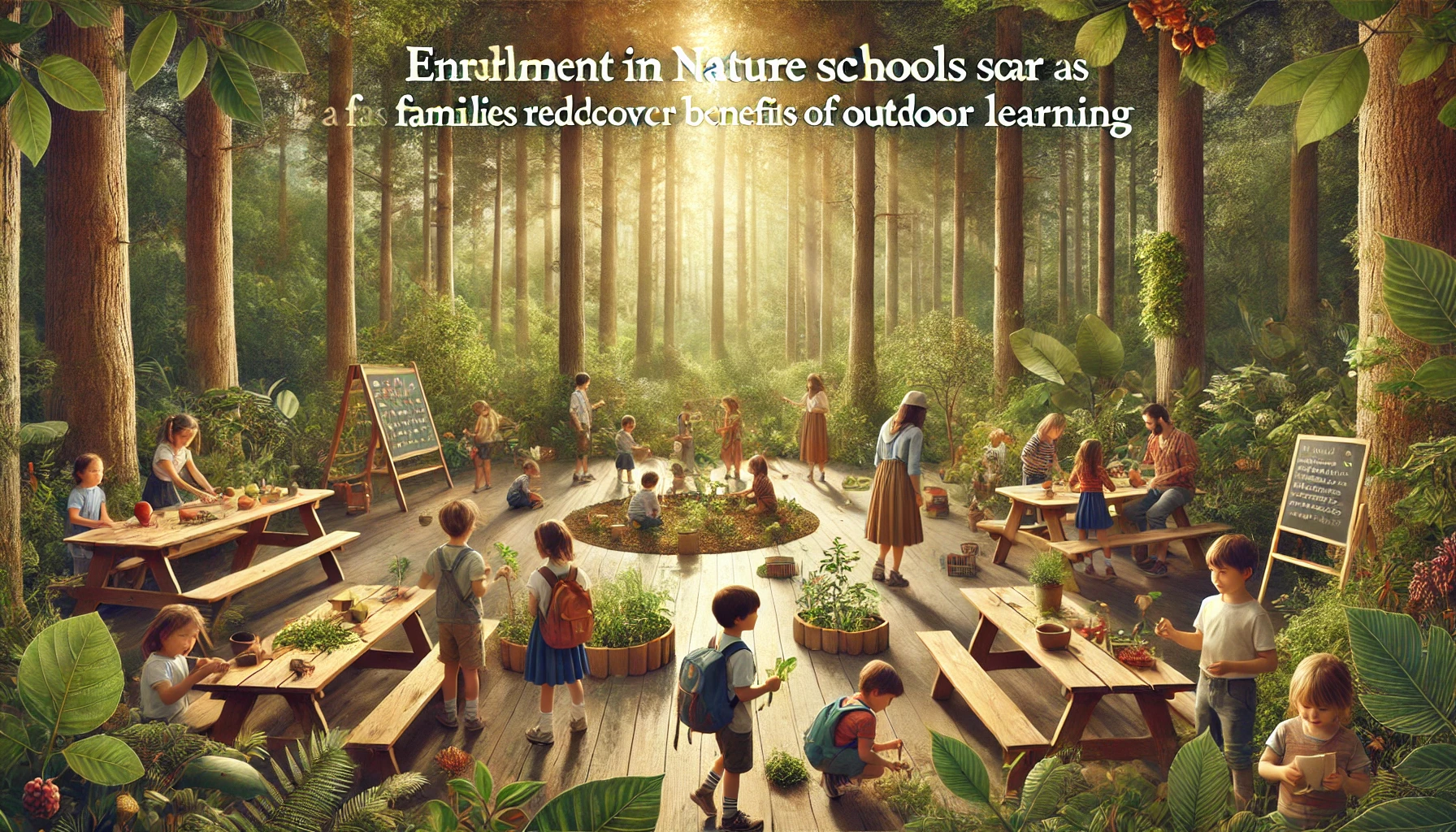
In the U.S., schools focusing on reconnecting children with nature have seen a marked increase in enrollment since 2020. For example, the LiberatED Podcast reports that Barefoot University Forest School “started with just a handful of families in the Dallas/Fort Worth area of Texas” in 2019 “and has now grown to serve more than 3,000 students nationwide.” Meanwhile, a 2022 national survey from the Natural Start Alliance found “an estimated 800 nature preschools in the United States, up more than 200 percent from 2017.”
A key reason for this shift is that outdoor schools present a reasonably safe alternative to online learning, which dominated the education world during the COVID-19 pandemic. “It was pretty difficult when all the schools in California shifted straight to [Zoom classes],” Garcia says. “I thought that was a little bit unfortunate, especially because there’s so much innovation [in this state], and we could easily move desks outdoors.”
Ian Abraham is the head of Oregon’s Portland Forest School, which “blends academics with hands-on learning” for K–eighth grade students. He believes the pandemic prompted parents to “see things through a different lens,” giving them “an opportunity to see that there might be something to their child learning out of doors in a more immersive, experiential environment.”
A 2023 study published in Frontiers in Psychology also points out how outdoor learning can boost motivation, engagement, communication, collaboration, critical thinking, and creativity.
Contrasting outdoor education with indoor schooling, Garcia says, “You can read a story about a woodpecker many times throughout the school year, but reading a story in front of an old oak tree while a woodpecker is pecking the tree next to you is an unbelievable experience. For kids to see what they’re reading in real life makes the learning experience incredible.”
Abraham recalls a project in which the members of a second-grade class broke into small groups, with each group searching for a different type of mushroom. After reconverging, the students sorted the mushrooms by species category based on morphology. Then they used the mushrooms as part of a math lesson. “The students were numbering, counting, and adding or subtracting to the piles of different kinds of mushrooms,” he explains.
Out With the Old, In With the Older
While Abraham sees the current outdoor education boom as a modern movement, he also feels this approach is “inherently old in so many ways. What we’re doing in our school is almost a [remembrance] of how things were before institutionalized education. This is how we have learned for tens of thousands, if not hundreds of thousands, of years. The combination of experiential [learning] and academics is helping parents remember that there’s something inherent to this that speaks well to a child’s development.”
Garcia notes, “I think there’s a general movement right now for some alternative ways of raising children. In our country, many people want to grow and make their own food and go outdoors with their children. If you look, [many] tech CEOs don’t send their children to schools with a lot of technology. We have to question: Why is that? It [is because it] stunts growth.”
She adds that there is a time and place for technology in education. “I don’t want my children or students to be completely inept at learning the technology around them. However, let’s say we’re doing a STEM skill activity, but you’re building on an iPad with your finger: What about using your hands and fine motor skills [by] building with popsicle sticks or sticks in the forest? There’s a major difference there [in terms of how you concentrate] and the way your brain works if you’re doing puzzles with your hands versus on a screen. There’s a lot of different learning using tactile objects or even just using a drill and screws versus creating something technologically.”
Like True Roots, Portland Forest School emphasizes the benefits of nature immersion on cognition and overall health. This includes relief from the harmful effects of excessive exposure to the electronic world.
“It seems like new studies come out on a three-or-four-month cycle about our anxious generation, the connection [of that] to social media, the lack of connection to self and people around us, and the literal brain chemistry changes that are happening due to the amount of time we are on our screens,” Abraham states.
However, while Abraham observes that decreased screen time “clearly benefits the brain,” he notes that Portland Forest School’s staff members “are not Luddites. I’m constantly on my phone [due to] my job. We have computers and work on assessments and research with Chromebooks at school. Our kids are not walking away wondering [how] to search on Google or how to cite a website.”
Weathering the Elements
True Roots operates rain or shine unless conditions like high winds, storms, intense heat, or poor air quality from smoke present a danger. Portland Forest School functions similarly: The school’s faculty and students spend 85 percent of their time outdoors, with tarps and dry erase boards enabling them to stay outside in rainy weather. Some indoor learning takes place on two small buses that serve as mobile classrooms while transporting attendees to different green spaces throughout Portland. The school also has a building for supplemental education, particularly in math.
“We often joke that we have field trips where we stay inside,” Abraham says. “That happens every so often when the weather is especially bad. Actually, sometimes the kids love it. They think it’s so special and weird: ‘I can take my shoes off? What are we doing?’”
By spending most of their time outdoors, nature school students are learning principles and practices that may prove valuable as the effects of climate change worsen. According to the National Wildlife Federation’s blog, “Across multiple research studies, outdoor education has been found to increase youth environmental sensitivity and stewardship.”
Garcia says True Roots helps instill eco-friendly habits and values. “We bring in a lot of sustainable practices to what we’re doing. We’re not allowed to pick anything or damage the terrain, and we’re trying to [educate] students about respecting the land around us and its importance.”
While Abraham acknowledges that climate change presents an “intense challenge,” he and his colleagues take comfort in “knowing that we’re teaching our kids a strong level of resiliency, adaptability, problem-solving, and resourcefulness.” For example, Portland Forest School’s curriculum includes “Earth skills” like water quality evaluation, fire safety, resource gathering, and survival strategies.
“Also, our kids inherently [have] love for the natural world, and you tend to want to protect, support, and endorse what you love,” Abraham states. “In all of that, a level of stewardship comes.”
Damon Orion is a writer, journalist, musician, artist, and teacher in Santa Cruz, California. His work has appeared in Revolver, Guitar World, Spirituality + Health, Classic Rock, and other publications. Read more of his work at DamonOrion.com.
This article was produced by Local Peace Economy.