


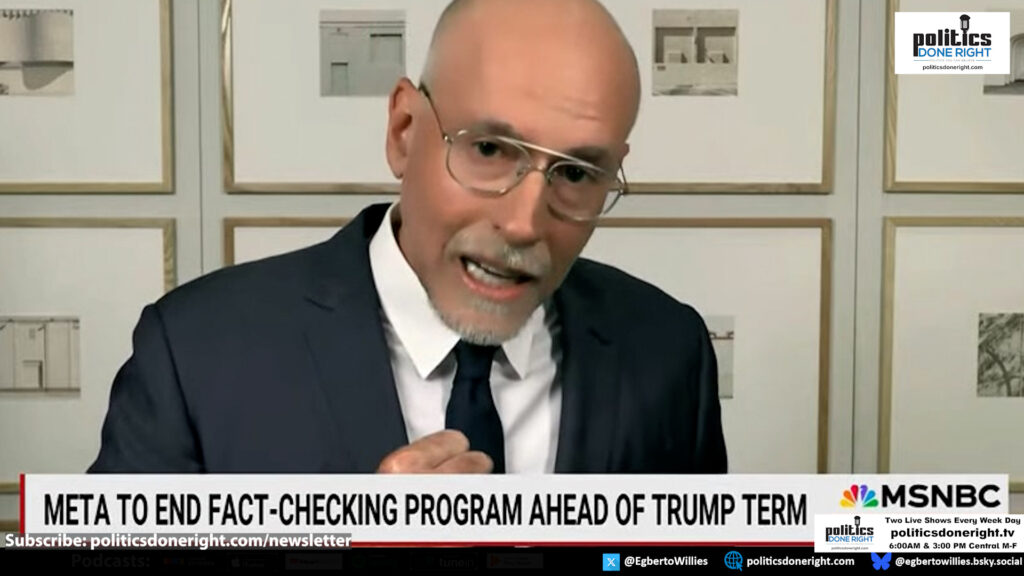
NYU professor Scott Galloway scorched Mark Zuckerberg and billionaires as he inferred that we would be on the cusp of a revolution if our income inequality trajectory continued.
A wealthy NYU professor infers a revolution.

Watch Politics Done Right T.V. here.

Podcasts (Video — Audio)
Summary
In a compelling Morning Joe appearance, NYU Professor Scott Galloway discusses the dangers of unchecked income inequality in America. He critiques capitalism’s monopolistic tendencies and highlights the erosion of the middle class, warning that such inequality risks societal upheaval. Galloway underscores the urgent need for higher taxes on the wealthy and stronger antitrust measures while advocating for a return to policies prioritizing broad-based prosperity. However, his solutions stop short of addressing the systemic nature of the crisis, leaving room for deeper progressive reforms.
- Capitalism’s Flaws: Galloway criticizes the shareholder-centric model that prioritizes profits over societal well-being, creating monopolies and economic inequality.
- Middle-Class Decline: He emphasizes the middle class as America’s most significant innovation, now endangered by stagnant wages, high costs, and diminished opportunity.
- Monopoly Power: Tech giants like Meta, Google, and Amazon are highlighted as monopolies that harm consumers, businesses, and democracy.
- Tax Inequity: Galloway reveals how the wealthy manipulate tax policies, with billionaires paying lower effective tax rates than middle-class earners.
- Looming Upheaval: He warns that extreme inequality is often corrected through war, famine, or revolution, urging immediate action to avoid societal collapse.
Galloway’s analysis highlights a critical truth: unchecked capitalism is failing most Americans. While his call for reforms like progressive taxation and antitrust action is essential, they must go further. A proper progressive solution requires de-commodifying essential services, empowering labor, and fostering equitable wealth distribution to build a just and sustainable economy that benefits all, not just the privileged few.
[ppp_patron_only level=2]
Income inequality has long been a central issue in discussions surrounding economic justice, the sustainability of capitalism, and the preservation of democracy. NYU Professor Scott Galloway‘s recent commentary on Morning Joe illuminated the dire state of America’s economic trajectory, where unchecked wealth concentration risks triggering a social upheaval. Galloway’s reflections on the failures of the capitalist framework—alongside his acknowledgment of the middle class as the backbone of American prosperity—offer an incisive critique of the prevailing system. Yet, his measured advocacy for reform stops short of proposing transformative solutions, revealing the limitations of economic thinkers who remain tethered to capitalist orthodoxy.
Capitalism’s Flawed Foundations
Capitalism’s has an inherent drive toward monopoly and wealth hoarding. Drawing from Milton Friedman’s philosophy, one must critique the shareholder-centric model prioritizing profits over societal well-being. The capitalist system, as it exists today, has proven itself predatory, exploiting workers while enriching a select few. Corporate behemoths like Amazon, Meta, and Google now dominate entire markets, stifling competition and innovation while increasing economic dependency on a few monopolistic entities.
This unchecked concentration of power perpetuates income inequality and societal harm. Galloway highlights stark examples: teenagers addicted to Instagram, skyrocketing rents for small businesses reliant on Amazon, and monopolistic tech giants consolidating global influence. Such trends deepen economic divides and contribute to a profound erosion of democratic values as wealth and political power become increasingly intertwined.
The Middle Class: An Endangered Innovation
One of Galloway’s most compelling points is his framing of the American middle class as the country’s most significant “innovation.” The middle class has historically been a stabilizing force, driving economic growth, financing public goods, and fostering societal cohesion. However, the hollowing out of this demographic through stagnant wages, skyrocketing healthcare costs, and diminishing job security threaten the foundation of American democracy.
When 40% of U.S. households struggle with medical or dental debt, and 20% of families with children face food insecurity, the promise of upward mobility fades. These harsh realities coexist with the obscene wealth accumulation by billionaires, some of whom now hold fortunes greater than the GDPs of small nations. Galloway’s question—“What is America?”—forces a reckoning with the nation’s priorities. Can a society that allows a fraction of individuals to hoard such wealth while millions suffer truly claim to uphold justice or fairness?
The Looming Threat of Revolution
Galloway’s warning about extreme inequality’s “self-correcting” nature should not be ignored. Historically, societies with unsustainable disparities have faced violent corrections through revolution, famine, or war. While he stops short of endorsing systemic overhauls, his acknowledgment of this risk underscores the urgency of addressing inequality through structural reforms.
His proposed solutions—higher taxes on the super-wealthy and a reversion to the tax policies of the mid-20th century—are a start but fall short of addressing deeper systemic issues. For instance, privatizing essential services such as healthcare, housing, and education ensures that inequality persists, even with progressive taxation. To rectify the imbalance, the United States must move toward de-commodifying these essential services, as Galloway hints when advocating for taking specific sectors out of the private sphere.
The Role of Political Agency
There is a need for political action. The systemic changes required to combat inequality demand academic discourse, grassroots mobilization, and progressive policymaking. The myth that Americans will eventually ascend to the ranks of the 1% has lulled many into supporting policies that harm them. Changing this narrative is essential to empowering voters to act in their economic interests rather than clinging to false aspirations.
Organizations, activists, and independent media platforms like Politics Done Right play a vital role in dismantling these myths. They challenge the status quo by exposing the mechanisms that transfer wealth from the many to the few and advocating for policies prioritizing the collective good. Without widespread education and civic engagement, the current trajectory is unlikely to change.
The Progressive Path Forward
Galloway’s insights offer a stark diagnosis of America’s economic ills, but the solutions must go further. True reform would involve redefining capitalism itself, shifting from a profit-driven model to one centered on equity and sustainability. Policies such as universal healthcare, robust labor protections, higher minimum wages, and stronger antitrust enforcement must accompany progressive taxation to dismantle the oligarchic structures that dominate today’s economy.
Moreover, the public must demand an economy that values human dignity over corporate profits. This means fostering a culture of accountability, where billionaires and corporations contribute their fair share to society. It also means strengthening unions, expanding public goods, and creating pathways for collective ownership to empower workers and communities.
Conclusion
Scott Galloway’s call to address income inequality serves as both a warning and a challenge. While his critique of capitalism’s excesses is incisive, the solutions he proposes must be bolder to match the scale of the crisis. The United States stands at a crossroads: either continue down a path of oligarchy and unrest or embrace transformative policies that restore balance and equity. The choice is clear, and the stakes could not be higher.
[/ppp_patron_only]