


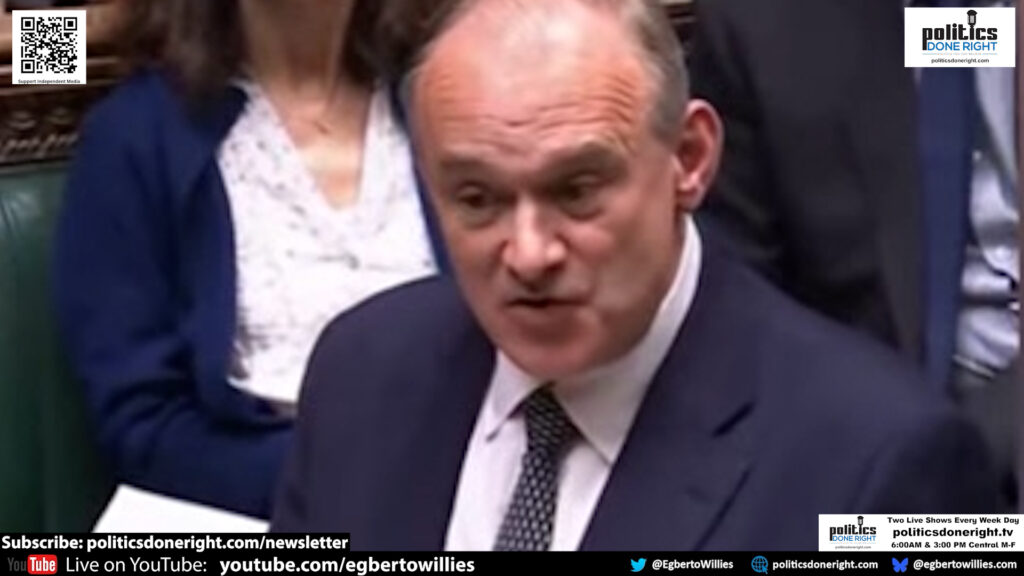
UK Liberal Democrat leader Ed Davey calls Trump a “dangerous and corrupt gangster,” warning of global instability and rejecting U.S. war escalation plans.
UK Leader Slams Trump

Watch Politics Done Right T.V. here.

Podcasts (Video — Audio)
Summary
A global rebuke exposes what many in the United States refuse to say out loud. In a striking moment from the British Parliament, Ed Davey delivers a blunt and unfiltered condemnation of Donald Trump, calling him a “dangerous and corrupt gangster.” The remarks underscore a widening gap between international alarm and domestic political silence.
- Ed Davey condemns Trump’s rhetoric as reckless, immoral, and outside international law.
- He warns that Trump’s proposed blockade of the Strait of Hormuz would escalate global conflict.
- The speech highlights how U.S. allies are increasingly distancing themselves from Trump’s leadership.
- The critique frames Trump’s conduct as not metaphorically but literally corrupt, citing behavior and business dealings.
- It calls for global cooperation independent of U.S. leadership to prevent further instability.
The takeaway is unmistakable: while many U.S. political leaders remain constrained by fear or partisan loyalty, the rest of the world is sounding the alarm. This moment reflects a broader struggle—not just about one man, but about whether democratic institutions can withstand authoritarian impulses cloaked in nationalism.
Premium Content (Complimentary)
One does not often hear such unvarnished language in formal parliamentary settings. Yet Ed Davey’s speech cuts through diplomatic niceties with surgical precision. It reflects a growing global impatience with what many see as the normalization of dangerous leadership emanating from the United States under Donald Trump.
The speech matters not because it is inflammatory, but because it is grounded in observable patterns. Davey’s critique—that Trump operates outside the bounds of international law and morality warns about the destabilizing effects of unilateral military actions and erratic foreign policy decisions. When a leader threatens catastrophic outcomes—such as the destruction of civilizations—those words carry consequences beyond rhetoric.
The proposed blockade of the Strait of Hormuz vividly illustrates this danger. Roughly a fifth of the world’s oil supply passes through that narrow channel. Any disruption would not only spike global energy prices but also deepen economic inequality, hitting working-class people hardest. Davey’s warning is therefore not abstract; it is rooted in material reality.
What makes the moment even more telling is the contrast between international clarity and domestic hesitation. Within the United States, many political actors—particularly within Trump’s party—have avoided direct confrontation. This silence reflects what political scientists describe as “elite accommodation,” where party leaders tolerate norm-breaking behavior to maintain political power. The result is a dangerous feedback loop: the more normalized the behavior becomes, the harder it is to challenge.
Davey’s use of the term “gangster” is especially provocative because it reframes the discussion. It shifts the focus from ideological disagreement to questions of ethics, legality, and accountability. It is important to maintain institutional integrity for democratic governance. When leadership appears to operate outside those norms—whether through conflicts of interest, disregard for the rule of law, or inflammatory rhetoric—the system itself becomes vulnerable.
The broader implication is that global alliances are adapting. Davey explicitly calls for cooperation among Europe, the Commonwealth, and Gulf partners to bypass destabilizing U.S. actions. Allies are increasingly hedging against unpredictability in American leadership by strengthening regional partnerships. In other words, the world is preparing for a future where U.S. leadership is no longer assumed to be stabilizing.
This shift carries profound consequences. For decades, the United States positioned itself as a defender of democratic norms. When allies begin to question that role, it signals not just a political disagreement but a structural change in global power dynamics. It also underscores a deeper truth: democracy depends not only on institutions but on the willingness of leaders—and citizens—to defend them.
Ultimately, the speech serves as both a warning and a call to action. It reminds listeners that the erosion of democratic norms rarely happens overnight. It occurs incrementally, through silence, complicity, and the gradual acceptance of behavior once considered unacceptable. By speaking plainly, Davey breaks that cycle, forcing a confrontation with reality.
The question now is whether others will follow. If global leaders continue to speak with clarity while domestic actors remain silent, the divide will only grow. But if the message resonates—if it emboldens those within the United States to challenge corruption and recklessness—then this moment could mark the beginning of a broader reckoning.
Democracy does not defend itself. It requires vigilance, courage, and a refusal to normalize the abnormal. That is the real lesson from this exchange in the British Parliament.