


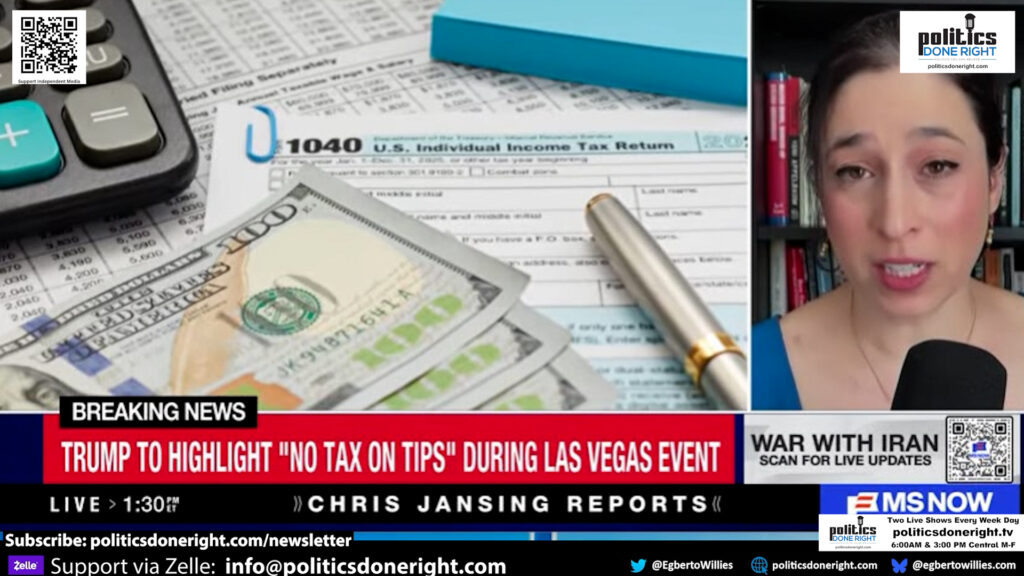
“No tax on tips” sounds helpful, but most workers gain little. Here’s why it’s a distraction from real economic reform.
The Truth About No Tax on Tips

Watch Politics Done Right T.V. here.

Podcasts (Video — Audio)
Summary
The so-called “no tax on tips” proposal exposes itself as political theater once the numbers and realities hit the table. It sounds generous, but for most working-class people who rely on tips, it delivers little to nothing while masking deeper inequities baked into the tax system.
- Many tipped workers already fall under the standard deduction, meaning they pay little to no federal income tax on reported income.
- A significant portion of tips—especially cash—often goes unreported, making the policy irrelevant to actual take-home pay.
- The proposal does not eliminate payroll taxes like Social Security and Medicare, which still reduce earnings.
- Any modest benefit pales in comparison to rising costs in healthcare, childcare, and housing.
- Tax breaks for working people often expire, while those for the wealthy remain permanent.
This policy does not materially improve workers’ lives. It functions as a distraction—offering symbolic relief while preserving a system that prioritizes wealth accumulation at the top over meaningful economic justice for the many.
Premium Content (Complimentary)
The rhetoric around “no tax on tips” sells a comforting illusion: that policymakers suddenly care about service workers struggling to make ends meet. But a closer examination reveals something far less generous and far more cynical. The proposal does not represent structural change; it represents a carefully crafted political mirage designed to sound pro-worker while leaving systemic inequities untouched.
First, the fundamental issue lies in how the tax system already treats low-income workers. The standard deduction—currently over $30,000 for married couples filing jointly—means that many tipped workers, especially those earning modest wages, already pay little to no federal income tax on their reported earnings. As highlighted in the transcript, this renders the “no tax on tips” proposal largely redundant for the very people it claims to help.
Second, the proposal deliberately obscures the distinction between income taxes and payroll taxes. Workers do not simply pay federal income tax; they also pay Social Security and Medicare taxes—collectively known as FICA. These taxes still apply to tips. The political messaging conveniently ignores this reality, creating the false impression that workers would keep all of their tips. In truth, a sizable portion would still be taxed.
This sleight of hand becomes even more troubling when placed in the broader economic context. According to research from institutions like the Economic Policy Institute, wage stagnation has persisted for decades despite rising productivity. Meanwhile, essential costs—healthcare, childcare, housing—have skyrocketed. In that environment, a marginal tax tweak on tips does nothing to address the structural imbalance squeezing working families.
Moreover, the policy ignores a critical reality: many tipped workers receive a portion of their income in cash that goes unreported. While this is not universal, it is common enough that eliminating taxes on reported tips would not significantly change their financial situation. In other words, the policy offers little new benefit where informal practices already exist.
The most revealing aspect of the proposal, however, lies in its asymmetry. Tax cuts targeting working-class people often come with expiration dates, while those benefiting corporations and billionaires are frequently permanent. This pattern reflects a broader policy orientation that prioritizes capital over labor. The video underscores this point by noting that temporary relief for workers contrasts sharply with enduring advantages for the wealthy.
Organizations like the Center on Budget and Policy Priorities have consistently shown that tax policy in the United States disproportionately benefits higher-income households. When policymakers introduce symbolic measures like “no tax on tips,” they reinforce a narrative that small, highly visible gestures can substitute for substantive reform.
If the goal were genuinely to improve the lives of tipped workers, policymakers would pursue more impactful solutions. Raising the federal minimum wage, eliminating the subminimum wage for tipped workers, expanding access to universal healthcare, and investing in affordable childcare would all provide tangible, lasting benefits. These measures address the root causes of economic insecurity rather than offering cosmetic fixes.
Ultimately, “no tax on tips” operates as a political distraction. It shifts the conversation away from systemic inequality and toward a narrow, misleading talking point. It asks workers to celebrate crumbs while the broader structure continues to funnel wealth upward.
A serious commitment to economic justice would reject gimmicks in favor of policies that redistribute power and resources. Until that happens, proposals like this will continue to serve their true purpose: not to uplift workers, but to placate them.