


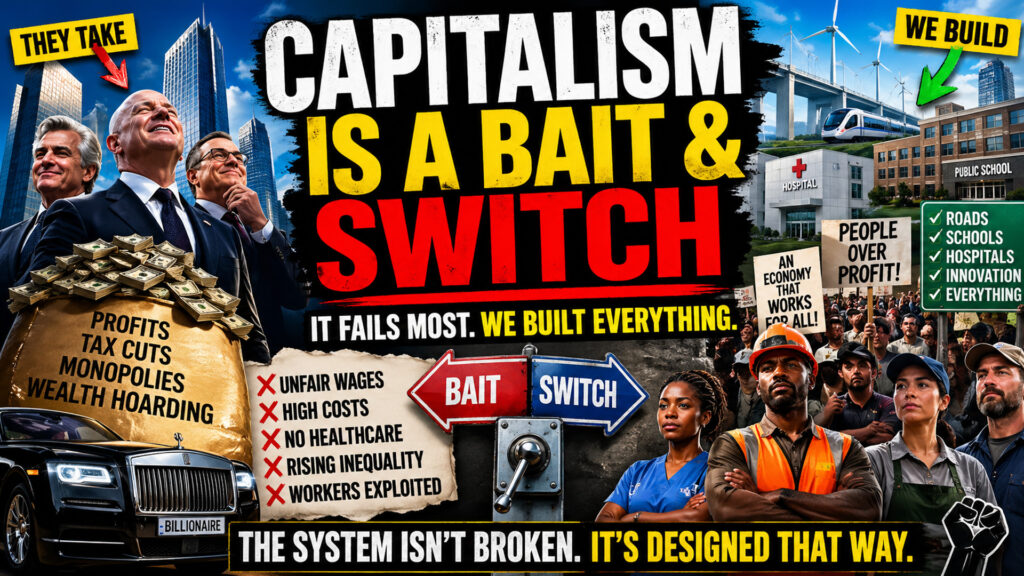
Workers built America, but billionaires took the credit. A sharp breakdown of the biggest myths of capitalism.
The Capitalism Myth Exposed

Watch Politics Done Right T.V. here.

Podcasts (Video — Audio)
Summary
For generations, Americans have been told that capitalism is natural, inevitable, and responsible for every advance in modern life. That story collapses under scrutiny. Workers build the roads, teach the children, invent the technologies, heal the sick, and create the wealth. Capitalism often steps in afterward to claim ownership, extract profit, and concentrate power.
- Innovation usually begins with public investment, university research, government grants, and collaborative labor—not with billionaire genius.
- Workers create value, but executives and investors capture disproportionate rewards through ownership structures.
- Many essentials, such as healthcare, housing, and energy, become more expensive when profit extraction takes precedence over public need.
- History shows that wealth concentration grows when markets operate without democratic guardrails, as documented by the Economic Policy Institute and the Federal Reserve.
- The real debate is not “capitalism or nothing.” It is whether society will build an economy that serves people rather than exploits them.
A humane economy would reward work, spread ownership, guarantee healthcare, strengthen unions, and treat public goods as rights. Once people reject the myth that concentrated wealth equals progress, they can begin building something fairer.
Premium Content (Complimentary)
Capitalism has long marketed itself as the engine of prosperity, innovation, and freedom. From classrooms to cable news, Americans hear the same refrain: without billionaires, nothing would be invented; without private profit, nothing would function; without concentrated wealth, society would stagnate. That narrative survives not because it is true, but because it benefits those who profit from it.
The first truth that must be stated clearly is this: people create wealth. Workers design software, construct buildings, grow food, transport goods, teach children, care for elders, and keep every system running. Capital does not wake up in the morning, solve engineering problems, or stock grocery shelves. Human beings do. Yet the prevailing system assigns ownership of collective output to a narrow class that controls assets rather than labor.
Consider technology. Many of the innovations credited to private moguls emerged from public funding and shared research. The internet grew from government-backed programs. GPS emerged through military and public investment. Foundational pharmaceutical research often begins with taxpayer-funded science through institutions such as the National Institutes of Health. Economist Mariana Mazzucato has extensively documented how the state frequently absorbs early risk while private firms later harvest profits.
The same pattern appears in labor markets. Since the late 1970s, worker productivity in the United States has risen sharply, while wages for typical workers have lagged far behind. The Economic Policy Institute has repeatedly shown the widening gap between what workers produce and what they are paid. That missing income did not vanish. It moved upward into executive compensation, shareholder returns, and concentrated fortunes.
Healthcare offers another revealing case. Americans pay more for medical care than residents of other wealthy nations while often receiving worse outcomes. Private insurers, administrative complexity, monopolized hospital systems, and pharmaceutical pricing power drive costs upward. Public programs like Medicare demonstrate that non-profit-oriented models can operate more efficiently in many areas. Yet privatization efforts continue because they create lucrative revenue streams.
Energy pricing also exposes the myth of neutral markets. Oil and gas prices often rise well beyond production costs when firms exploit manufactured scarcity, geopolitical fear, or market concentration. Consumers then pay more at the pump while producers report windfall profits. Markets do not merely “discover” prices; powerful firms frequently shape them.
Defenders of the status quo often frame any criticism as an attack on freedom or entrepreneurship. That is false. A progressive economic vision does not require abolishing markets, banning private business, or suppressing initiative. It requires democratizing the economy so that those who create value share in its rewards.
That means stronger unions so workers can bargain collectively. It means employee ownership models and cooperatives that spread wealth creation. It means universal healthcare detached from employment. It means antitrust enforcement against monopolies. It means progressive taxation that funds education, transit, childcare, and green infrastructure. It means recognizing housing, healthcare, and dignity as social priorities rather than speculative commodities.
Even the Federal Reserve data on household wealth show extreme concentration, with the top tier controlling a vastly disproportionate share of assets. Such inequality is not an accident. It is a design feature of systems that privilege ownership over labor.
The deepest bait-and-switch of capitalism is convincing ordinary people to identify with the few who exploit them rather than with the many who sustain society. Workers are told to admire billionaires while struggling to afford rent, medicine, and retirement. They are urged to defend tax cuts for the wealthy while public schools deteriorate. They are promised that riches at the top will trickle down —trickle-down economics —even as ladders upward are removed.
A better future begins when people reject that mythology. The question is not whether society can afford justice. The question is whether society can continue to afford extraction. Real prosperity comes when wealth circulates broadly, opportunity is universal, and democracy reaches the workplace as well as the ballot box. The economy should be judged by how well it serves the many, not how extravagantly it rewards the few.