


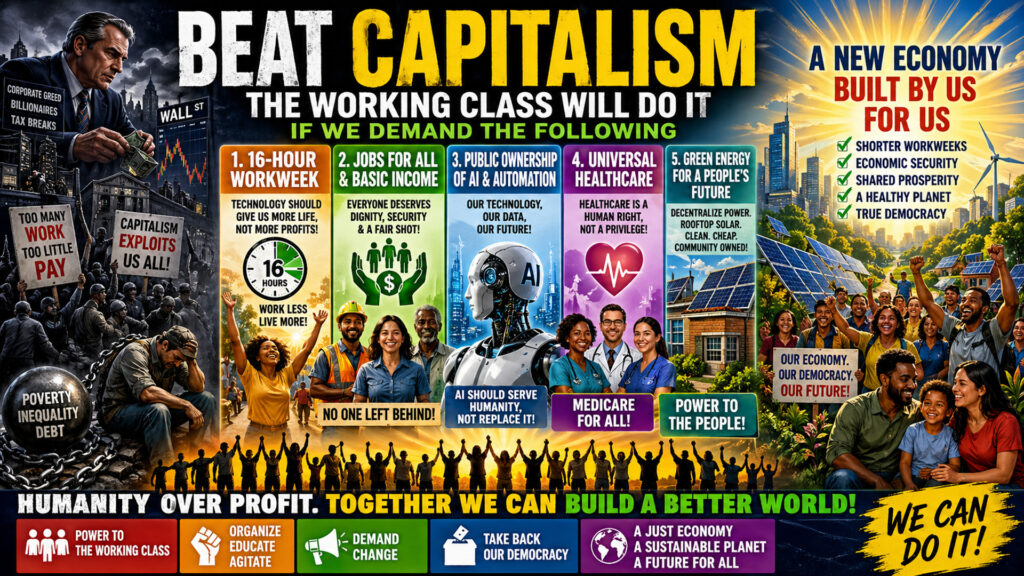
Capitalism is failing working people. Explore solutions like job guarantees, public AI, and universal healthcare to build a fair economy.
Beating Capitalism

Watch Politics Done Right T.V. here.

Podcasts (Video — Audio)
Summary
A system that extracts from the many to enrich the few must be confronted—and replaced with one that serves humanity first. We must consider a bold framework for how working people can reclaim power and redesign the economy.
- The current economic model concentrates wealth while exploiting workers and masking its failures through indoctrination.
- Productivity gains from automation should reduce work hours—not increase profits for a select few.
- A humane economy requires a 16-hour workweek, job guarantees, and basic income to ensure dignity for all.
- Public ownership or democratic control of transformative technologies like AI prevents exploitation.
- Universal healthcare and decentralized energy systems are essential to freeing people from economic coercion.
The path forward is not theoretical—it is practical, achievable, and necessary. When working people demand systemic change, they can dismantle extractive capitalism and build an economy rooted in shared prosperity and human dignity.
Premium Content (Complimentary)
The narrative around capitalism has long relied on a carefully constructed illusion: that the system rewards merit, fosters innovation, and ultimately benefits everyone. But a closer look reveals a different reality—one where the fruits of collective labor are siphoned upward, leaving workers struggling while wealth consolidates at the top. This contradiction is unmistakably clear. More importantly, the narrative here offers a blueprint for change grounded in both logic and lived experience.
The first pillar of that blueprint challenges one of capitalism’s most entrenched norms: the 40-hour workweek, a reality labor unions fought valiantly for. Advances in automation and artificial intelligence have drastically increased productivity. According to research from the Economic Policy Institute, worker productivity has surged for decades while wages have stagnated. The logical conclusion is not that workers should produce more—it is that they should work less while maintaining their standard of living. A 16-hour workweek represents not a utopian fantasy but a rational redistribution of efficiency gains. When machines take over labor, the benefit should accrue to society, not just shareholders.
This idea connects directly to the need for a job guarantee and basic income. During the COVID-19 pandemic, the U.S. government demonstrated that it can inject money into the economy to prevent collapse. Economists across institutions, including the International Monetary Fund, acknowledged that such interventions stabilized demand and prevented more serious economic damage. Yet policymakers framed these measures as temporary emergencies rather than evidence of what is structurally possible. A permanent system that ensures income security would not only reduce poverty but also empower workers to demand fair conditions without fear of destitution.
The conversation around artificial intelligence further exposes the contradictions of capitalism. AI is a collective product—built from public research, human knowledge, and shared data. Yet its ownership remains concentrated in private hands. This privatization allows corporations to extract profits while displacing workers. Public or democratic control of AI is necessary to reverse that dynamic, ensuring that technological progress benefits society as a whole. Contrary to the claim that only private markets drive innovation, history shows that government-funded research—from the internet to GPS—has been foundational to technological advancement.
Energy policy provides another clear example of how capitalism limits progress. The widespread adoption of rooftop solar could transform cities into decentralized power networks, reducing costs and environmental impact. However, such a model threatens existing profit structures in the energy sector. Reports from the International Energy Agency consistently highlight the viability of distributed renewable energy systems. The barrier is not technological—it is political and economic. A people-centered approach would prioritize sustainability and resilience over corporate margins.
Healthcare remains perhaps the most glaring failure of the current system. Tying access to medical care to employment creates a form of economic coercion, aka antiseptic slavery, where individuals must remain in jobs they might otherwise leave simply to maintain coverage. Studies from the Kaiser Family Foundation show that millions delay or forgo care due to cost concerns. A universal system—often framed as Medicare for All—would eliminate this burden, allowing people to seek care without fear and to pursue work that aligns with their skills and aspirations rather than their insurance needs.
At its core, there must be a simple but profound shift: placing humanity above profit. This shift requires more than policy tweaks; it demands a reimagining of economic priorities. The current system assumes that markets should dictate outcomes, even when those outcomes undermine collective well-being. A humane economy flips that assumption, using democratic processes to guide production and distribution in ways that serve society.
Critics often dismiss such proposals as unrealistic. Yet history tells a different story. The 40-hour workweek itself was once considered radical. Social Security, Medicare, and labor protections all faced fierce opposition before becoming pillars of economic stability. Change does not emerge from inevitability; it emerges from organized demand.
This is our call to action rooted in collective power. No single individual holds all the answers, but together, working people possess the knowledge and capacity to design a better system. By demanding policies that reflect shared interests—reduced work hours, income security, public control of essential resources, and universal healthcare—they can dismantle an extractive model and replace it with one that values dignity, equity, and sustainability.