EgbertoWillies.com

Political involvement should be a requirement for citizenship

  • Home
    • Homepage
    • Login
    • About Us
    • Bio
    • Research
      • BallotPedia
      • Bureau of Labor Statistics
      • CallMyCongress
      • LegiScan
      • OpenSecrets.org
      • Texas Legislature Online
      • US Dept; Of Health & Human Services
      • US Dept. of Labor
      • VoteSmart
    • Contact Us
    • Disclaimer
    • Privacy Policy
  • Shows
    • Live TV
    • Move to Amend Reports
    • Politics Done Right
  • Books
  • Articles
    • AlterNet
    • CNN iReports
    • CommonDreams
    • DailyKos
    • Medium
    • OpEdNews
    • Substack
  • Activism
    • Battleground Texas
    • Coffee Party
    • Move To Amend
    • OccupyMovement
  • Social
    • BlueSky
    • Facebook
    • Instagram
    • Pinterest
    • Tumblr
    • Twitter
    • YouTube
  • Sections
    • Environment
    • Food And Cooking
    • Health
    • Local News
    • Odd News
    • People Making A Difference
    • Political
    • Reviews
      • Book Reviews
      • Books I Recommend
      • Product Reviews
    • Sports
    • Substack Notes
  • Donate
  • Store

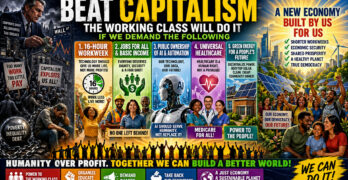
Beating Capitalism: 16-Hour Workweek, AI for People & Medicare for All Explained
May 5, 2026 By Egberto Willies Leave a Comment

Beating Capitalism: 16-Hour Workweek, AI for People & Medicare for All Explained

Capitalism is failing working people. Explore solutions like job guarantees, public AI, and universal healthcare to build a fair economy.

Filed Under: General Tagged With: 16 hour workweek, Artificial Intelligence, automation, capitalism, Economic Justice, economic reform, future of work, healthcare reform, job guarantee, labor rights, Medicare For All, Progressive Policy, public ownership, renewable energy, rooftop solar, Social Democracy, Universal Basic Income, wealth inequality, working class

The Hidden Link Between EV, Tariffs, Wind Energy, Greenland, Venezuela, and Oil Imperialism

December 27, 2025 By Egberto Willies

The debate around electric vehicles, windmills, Greenland, Venezuela, oil, and tariffs often appears fragmented, as if each issue exists in its own policy silo. That illusion serves power well. When examined together, these issues reveal a coherent and troubling strategy rooted in protecting entrenched corporate interests—particularly fossil fuels—through coercion, misinformation, and state intervention. The common thread between EVs, … Tariffs on Chinese-made electric vehicles offer the first clue. Classical capitalism argues for efficiency: if another country produces a superior product at lower cost, markets should reward that efficiency. Instead, punitive tariffs block affordable EVs while U.S. automakers scale back production. This is not market correction; it is market distortion. The private sector failed to invest aggressively in EVs when it had the chance, and now the state shields that failure rather than confronting it. That choice delays climate progress and leaves working families paying more for fewer options. The same logic explains the hostility toward wind energy. Offshore wind projects—many led by Danish firms like Ørsted—represent large-scale threats to oil’s dominance. Claims that turbines threaten national security collapse under basic physics and radar science. Modern militaries already distinguish complex signal environments. What truly alarms fossil interests is that wind power reduces dependence on oil, shrinking profits and geopolitical leverage. That fear also clarifies renewed fixation on Greenland. Greenland holds vast reserves of rare earth minerals essential for renewable energy and advanced electronics. Though self-governing under Denmark, Greenland faces external pressure framed as “strategic interest.” This echoes earlier imperial patterns: identify resources, question sovereignty, insert influence. The outrage from Danish and Greenlandic leaders reflects a fundamental truth—resource desire, not defense, drives this attention. Venezuela fits squarely into the same pattern. The country sits atop some of the world’s largest oil reserves and significant mineral wealth. For decades, U.S. policy has punished Venezuela through sanctions, asset seizures, and maritime enforcement, all while claiming humanitarian concern. Yet countries like Norway demonstrate that public stewardship of resources can fund social welfare without economic collapse. Venezuela’s crime, in Washington’s eyes, was asserting sovereignty over its wealth rather than surrendering it to multinational corporations. Oil companies themselves expose the contradiction. Firms like BP once rebranded as forward-looking energy leaders, promising transition. Those campaigns vanished once profits surged. Instead of reinvesting excess earnings into renewables, corporations doubled down on extraction, lobbying governments to block competitors like wind and EVs. This is not capitalism evolving—it is capitalism captured. At the center of these choices stands political leadership that embraces spectacle over strategy. Under Donald Trump, renewable projects halted on whim, tariffs replaced planning, and foreign policy blurred into open resource intimidation. Such instability undermines even the business community, which relies on regulatory certainty to invest and innovate. When policy shifts with personal bias, economies stagnate. The common thread, then, is imperial protectionism: using state power to preserve corporate dominance while denying both citizens and other nations the benefits of technological and economic progress. Tariffs replace industrial policy. Sabotage replaces transition. Coercion replaces diplomacy. Democracy becomes collateral damage. Progressive policy offers a different path—one rooted in public investment, energy democracy, international cooperation, and respect for sovereignty. Markets can function, but only when they serve people rather than empires. The future economy—clean, distributed, and equitable—will not emerge from fear-driven policy. It will emerge when voters demand leadership willing to break from extraction and embrace transition.

The fight over EVs and renewables exposes how resource extraction still drives U.S. economic and foreign policy.

Filed Under: General Tagged With: clean energy, Climate Justice, corporate power, energy policy, EV tariffs, fossil fuels, geopolitics, Greenland, imperialism, oil politics, progressive economics, renewable energy, venezuela, Wind Power

What are some innovative ways companies are accessing renewable energy nowadays?
July 2, 2024 By EarthTalk

With energy production accounting for upwards of 75 percent of global greenhouse emissions and more and more companies looking to reduce their carbon footprints, it makes sense that a whole new generation of start-ups would spring to life to help put business customers together with green energy producers.

Filed Under: Environment, Evergreen Tagged With: renewable energy

We can print money responsibly to fulfill all our progressive policy requirements.

May 15, 2024 By Egberto Willies

We can print money responsibly to fulfill all our progressive policy requirements.

We have been indoctrinated to transfer our income and wealth to the top continuously. The fact is, we can print money responsibly without borrowing money from the oligarchy.

Filed Under: General Tagged With: corporate greed, deficit spending, dollar value, economic investments, economic stability, Economic Stimulus, fiscal policy, government bonds, green infrastructure, inflation control, interest payments, Modern Monetary Theory (MMT), productive capacity, progressive policies, renewable energy, sovereign currency, Stephanie Kelton, Universal Healthcare, wealth inequality, wealth transfer

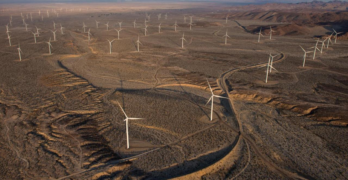
Is there any future for small residential wind turbines as we transition to more renewable forms of energy?

April 30, 2021 By EarthTalk

Is there any future for small residential wind turbines as we transition to more renewable forms of energy?

You see a lot of people putting solar panels on their homes these days, but windmills not so much. Is there any future for small residential wind turbines as we transition to more renewable forms of energy?

Filed Under: Environment, Evergreen Tagged With: renewable energy, wind turbines

As the rest of the world future(ise), Trump & Plutocracy puts America in decline
October 16, 2018 By Egberto Willies

As the rest of the world future(ise), Trump & Plutocracy puts America in decline

It is hard to imagine that America is destined for a continued decline during a Trump reign sanctioned by the American Plutocracy for at least four years.

Filed Under: General Tagged With: renewable energy, Scottish Power, Wind Power

China is beating the U.S. all over as the U.S. degrade into what China was
May 27, 2018 By Egberto Willies

China beating the U.S. all over as the U.S. degrade into what China was

We can blame no one but ourselves for degenerating into a stance of willful ignorance to satisfy a select few solely to maintain some ideological power as China and others progress.

Filed Under: General Tagged With: China, Donald Trump, green energy, renewable energy, USA

10% Discount Coupon Code: POLITICSDONERIGHT

Follow Us

  • Facebook
  • X
  • YouTube
  • Instagram
  • Pinterest
  • Tumblr
  • LinkedIn

Politic Done Right


Support Independent Media


Mastodon

RSS Feed

  • RSS - Posts