Whitney Houston turned Dolly Parton’s song into a global phenomenon. What Dolly did with some of those millions helps explain why Black America embraced the country legend.


Summary
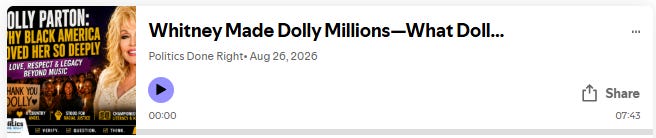
Dolly Parton’s death at 80 has generated an extraordinary outpouring of affection that extends far beyond country music, including within Black America. One revealing reason appears in The Reality Check: Whitney Houston turned Parton’s “I Will Always Love You” into a worldwide phenomenon, generating millions in songwriting royalties for Parton. Parton then used some of that wealth to buy her Nashville office complex in what was then a predominantly Black neighborhood, affectionately calling it “the house that Whitney built.”
- Whitney Houston multiplied the value of Parton’s song. Houston’s 1992 performance in “The Bodyguard” transformed a country composition into an international cultural landmark. Parton openly acknowledged Houston’s contribution rather than pretending the song’s extraordinary second life belonged to her alone.
- Parton put some of the resulting capital into a Black Nashville neighborhood. This was an investment rather than a charitable grant, an important distinction, but Parton explicitly connected the purchase to Houston and the community around it.
-
She recognized shared economic creation. The discussion correctly identifies the deeper lesson: wealth rarely emerges from a single person. Houston’s talent created enormous additional value for intellectual property Parton owned.
-
Her racial solidarity went beyond symbolism. Parton publicly supported Black Lives Matter, rejected the notion that only white lives deserved recognition, and later removed “Dixie” from the name of her dinner attraction amid concerns about Confederate associations.
-
Her philanthropy reinforced that reputation. Her Imagination Library ultimately distributed more than 300 million free books worldwide, while her giving also supported disaster victims, medical research, pediatric care, and education.
Parton demonstrated something America’s billionaire class too often forgets: ownership does not erase interdependence. Whitney Houston added immense economic value to Parton’s creation, and Parton understood that enrichment carried a social dimension. That humility helps explain why affection for her crossed racial, cultural, geographic, and political boundaries.
PLEASE BECOME A PAID SUBSCRIBER TODAY
Countering billionaires—and soon trillionaires—is hard, probing work. They flood the zone with propaganda, policy distortions, and economic fallacies rooted in the Powell Memo and financed by concentrated wealth. We work every day to answer that machinery with truth, context, and critical thinking. But independent media cannot survive on conviction alone. It needs support from people who understand the stakes. Please become a paid subscriber today. Your support keeps this work alive, expands its reach, and helps build a media ecosystem that serves people, not plutocrats. This is not charity. It is an investment in truth, democracy, and the public good.
Premium Content (Complimentary)
Why Dolly Parton’s Relationship With Whitney Houston Helps Explain Her Love in Black America
Dolly Parton’s death at 80 closes an extraordinary American life, but the reaction to her passing reveals something more interesting than celebrity nostalgia. Parton belonged culturally to people who did not necessarily listen to country music, live in Appalachia, or share the politics often associated with rural Tennessee. Black America’s affection for her offers a powerful example.
The Whitney Houston story helps explain why.
Parton wrote “I Will Always Love You” in 1973. Nearly two decades later, Houston recorded the song for The Bodyguard. Her performance turned an already-successful country composition into one of the defining popular recordings of the modern era. Because Parton retained her songwriting rights, Houston’s success produced millions in royalties for her.
Parton understood what had happened.
She did not pretend that ownership alone created all that new value. Houston’s artistry, voice, interpretation, cultural reach, and audience had transformed the economic potential of Parton’s intellectual property. Parton later recalled becoming so overwhelmed the first time she heard Houston’s version that she pulled her car off the road just to listen.
Then came the detail that deserves attention.
Parton used some of those proceeds to purchase her Nashville office complex in an area that was then predominantly Black. She explicitly connected that decision to Houston, describing the property as “the house that Whitney built.” The program correctly highlights that moment because it exposes a very different conception of wealth from the one promoted by America’s extractive economic culture.
It should not be romanticized into something it was not. Parton did not donate the royalties wholesale to a Black neighborhood. She bought property there. That was an investment. But the intent still matters. A wealthy white country superstar deliberately recognized that a Black woman had dramatically increased the value of her work and chose to associate some of that wealth with Houston’s community rather than erase Houston from the economic story.
That distinction becomes especially relevant in an economy where billionaires routinely describe fortunes produced by thousands of workers as if a single heroic entrepreneur created every dollar.
Parton demonstrated another instinct: remember who helped create the value.
Her broader record strengthens the point. She publicly supported Black Lives Matter when racial justice protests swept the country. She backed LGBTQ+ equality. Her Imagination Library distributed hundreds of millions of free books to children. She contributed to medical research, disaster relief, pediatric care, and education. Reuters reports that the program had distributed more than 304 million books across five countries by the time of her death.
None of that makes anyone politically perfect. It does, however, illustrate why Parton transcended the usual cultural boundaries.
The transcript makes the economic argument explicitly: if wealthy Americans routinely understood that their fortunes depended upon workers, artists, consumers, communities, infrastructure, and generations of public investment, society would spend far less time fighting over how to tax concentrated wealth.
That is the progressive lesson in the Dolly-and-Whitney story.
Parton owned the song. Houston magnified its value. Millions of listeners completed the economic circle. Parton recognized that connection.
Capitalism constantly tells owners, “It is all yours.” Humanity reminds them, “Nobody built it alone.”
Dolly Parton seemed to understand the difference.