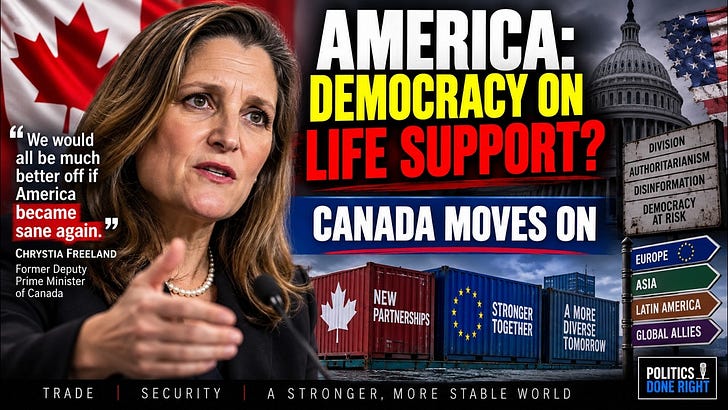
Chrystia Freeland says U.S. democracy is on life support as Canada diversifies trade and Trump’s policies drive longtime democratic allies away.


Summary
Former Canadian Deputy Prime Minister Chrystia Freeland delivered a warning Americans should take seriously: the rest of the democratic world is no longer willing to organize its future around the assumption that the United States will remain a stable, reliable partner. Canada is diversifying its economic relationships, longtime allies are reassessing their dependence on Washington, and Freeland argues that the United States—not Europe—is now the most precarious center of the democratic struggle. Her most important challenge was aimed not simply at Donald Trump, but at Americans themselves: What will they choose next?
- Trump’s second election fundamentally changed how allies view America. Freeland said Canadians understood Trump had been elected twice, causing many to wonder whether the United States could ever again be fully trusted.
- Canada is actively reducing its dependence on the United States. Freeland pointed to Canada’s trade agreement with the European Union and said diversification will continue.
-
America has become the weak point in the democratic alliance. Freeland called the United States the global “ground zero” in the struggle between democracy and authoritarianism and said Europe is currently “less shaky” than America.
-
Legitimate working-class anger fueled the backlash against globalization. Freeland acknowledged that China’s entry into the WTO damaged Western manufacturing communities and eliminated many blue-collar union jobs. But she argued that attacking democratic allies only makes China stronger.
-
The ultimate question is what Americans will tolerate. Freeland said she cares less about Trump changing his behavior than about whether ordinary Americans choose to continue “down this dark path” or choose something else.
Canada is not celebrating American decline. It is preparing for it. A progressive America must rebuild democratic institutions, restore working-class economic security, strengthen alliances among democracies, and reject the authoritarian nationalism that turns friends into enemies while empowering oligarchs and geopolitical rivals.
PLEASE BECOME A PAID SUBSCRIBER TODAY
Countering billionaires—and soon trillionaires—is hard, probing work. They flood the zone with propaganda, policy distortions, and economic fallacies rooted in the Powell Memo and financed by concentrated wealth. We work every day to answer that machinery with truth, context, and critical thinking. But independent media cannot survive on conviction alone. It needs support from people who understand the stakes. Please become a paid subscriber today. Your support keeps this work alive, expands its reach, and helps build a media ecosystem that serves people, not plutocrats. This is not charity. It is an investment in truth, democracy, and the public good.
Premium Content (Complimentary)
Canada Is Warning America: The World Will Not Wait for Democracy to Recover
Chrystia Freeland did something American political media too often refuses to do: she described the democratic crisis facing the United States without sanitizing it.
The former Canadian deputy prime minister and finance minister warned that Canadians no longer view American instability as a temporary aberration. Donald Trump won the presidency twice. That fact matters beyond American borders because governments make long-term decisions based on whether another country can keep its commitments from one election to the next.
Freeland said Canadians increasingly wonder whether the United States can ever be trusted again. That is an extraordinary statement coming from one of America’s closest allies.
And Canada is acting accordingly.
Freeland explained that Canada has spent decades attempting to diversify its trade, including through its agreement with the European Union. Now that diversification has become urgent rather than optional.
Current events prove the point. On September 8, 2026, Canada imposed counter-tariffs of 15%, 25%, and 50% covering C$27.6 billion of American imports, matching U.S. tariffs dollar for dollar. The measures target sectors including steel, dairy, appliances, agricultural equipment, pulp and paper, plastics, and electronics.
This is what happens when nationalist political theater collides with economic reality. Trade wars between deeply integrated economies do not punish some abstract foreign adversary. They disrupt workers, manufacturers, farmers, supply chains, and consumers on both sides of the border.
But Freeland’s sharper warning concerned democracy.
She called the United States “ground zero” in the global battle between democracy and authoritarianism and told her interviewer that Europe is currently “less shaky” than America. She even characterized American democracy as being on “life support.”
Independent democracy researchers give Americans little reason to be complacent.
Freedom House still classifies the United States as “Free,” but its 2026 score fell from 84 to 81 out of 100. The organization cites institutional dysfunction, growing pressure on government oversight, erosion of media independence, political polarization, and other threats to fundamental rights.
The V-Dem Institute offers an even more alarming assessment. Its 2026 Democracy Report says American liberal democracy deteriorated unprecedentedly in 2025, including executive overreach, weakening legislative constraints, attacks on dissent and the press, and declining civil rights protections. V-Dem says the United States fell from 20th to 51st among 179 countries on its Liberal Democracy Index.
Progressives should also resist the temptation simply to defend the pre-Trump economic order. Freeland conceded something neoliberal elites ignored for too long: globalization inflicted severe costs on manufacturing workers. China’s integration into world markets devastated communities whose factories disappeared and whose union jobs never came back.
Trump correctly exploited that anger. He offered the wrong cure. Of course, he tore the scab that hid America’s entrenched racism and used it as a tool to assist.
A progressive alternative would rebuild domestic manufacturing, empower organized labor, enforce fair trade rules, tax multinational corporations that offshore production, and cooperate with democratic allies rather than casually threatening them.
And this is where Freeland delivered her most profound challenge.
She said she is less interested in whether Donald Trump changes than in what ordinary Americans choose. Will they continue down this path, or choose something else?
That is the question.
America cannot demand trust because of what it once represented. It must earn trust through what it does now.