Pigs are fascinating animals. Science shows they can solve challenging problems, love to play, display wide-ranging emotions, and have unique personalities. In short, they are both intelligent and sentient—capable of feeling. It’s clear that it is illogical and immoral to treat pigs as mere objects.
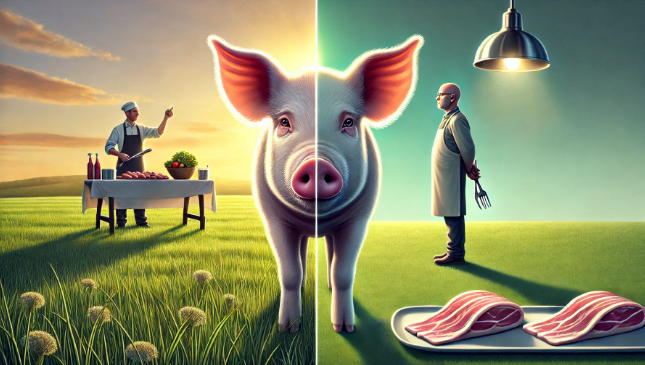
In 2015, I reviewed an essay notable for its summary and distillation of research on sentience in pigs. Compiled by researchers Lori Marino and Christina M. Colvin and published in the International Journal of Comparative Psychology, “Thinking Pigs: A Comparative Review of Cognition, Emotion, and Personality in Sus domesticus” unearthed some interesting findings.
The main aims of the paper were to present pig psychology separate from its role in agriculture and pinpoint critical areas for further exploration. To accomplish these aims, “Thinking Pigs” considered various topics, including domestication, sensory abilities, learning skills, time perception, spatial learning and memory, novelty seeking, social cognition and complexity, self-awareness, personality, curiosity, and play.
“Pigs display consistent behavioral and emotional characteristics that have been described variously as personality… [:] coping styles, response types, temperament, and behavioral tendencies,” the researchers concluded. Advocating for greater respect and understanding of pigs’ complex mental capacities, the authors called for a shift in how humans perceive and interact with them.
The Cognitive Lives of Pigs
Since “Thinking Pigs” was published, many other studies have shown that pigs possess cognitive abilities widely accepted as indicating “human-like” intelligence. For example, a 2023 explainer by Rachel Graham for Sentient Media titled “Pigs Are Intelligent and Clean Animals, Actually” cites several studies revealing pigs to be even more sociable and intelligent than was previously known.
Pigs use tools in different situations and have been seen using sticks to dig and build a nest. Like primates (including humans), wolves, and birds, pigs employ third-party mediation, adopting a “triadic contact” strategy to resolve group disputes.
Significantly, a 2009 study showed that pigs could interpret a mirror image to find a food bowl and demonstrated a marked interest in their reflections. This is notable because the mirror or mirror self-recognition (MSR) test has long been used to measure self-recognition and cognitive self-awareness in nonhuman animals. Very few species have demonstrated these behaviors: great apes, bottlenose dolphins, orcas, manta rays, Eurasian magpies, domestic pigeons, and cleaner wrasses.
In 2021, scientists reported seeing and recording a female wild sow successfully figuring out how to rescue two young wild boars from a trap, demonstrating remarkable problem-solving skills.
The Emotional Lives of Pigs
While referring to the emotional lives of pigs, the authors of “Thinking Pigs” noted, “Some of the more interesting studies demonstrating emotional contagion in pigs involve responses to other pigs’ anticipation of positive or negative events, revealing the importance of social factors in emotion.”
In one study (Reimert, Bolhuis, Kemp, and Rodenburg, 2013), naive test pigs were exposed to pen mates trained to anticipate upcoming rewarding events (receiving straw and chocolate raisins) or aversive events (social isolation). When the naive pigs were placed in the company of the trained pigs, they adopted the same emotional anticipatory behaviors (for example, ear and tail postures and increased cortisol release) as the trained pigs with the direct experience. These findings show that not only can pigs connect with the emotions of other pigs but they can also adopt the behaviors of their pen mates, who respond emotionally in anticipation of future events.
The rescue incident mentioned above, where a wild sow was filmed saving the young from a trap, suggests the species’ capacity for deep emotion. During the rescue effort, she exhibited piloerection (bristles on her back standing up), which is typically a sign of distress and indicates an empathetic emotional state.
Does It Matter If Pigs Are Smarter Than Dogs?
I came across a 2013 article by David Crary in the Associated Press titled “Pigs Smart as Dogs? Activists Pose the Question.” As a scientist who has studied the cognitive and emotional capacities of a variety of nonhuman animals and as an adviser to The Someone Project—an initiative by the nonprofit Farm Sanctuary “documenting farm animal sentience through science”—I have addressed some of the points raised in the article using solid scientific research as a foundation.
First, as I have noted in several reports (for example, in an article “Dogs Are Brainier Than Cats, But Are They Really Smarter?” and in another titled, “Do ‘Smarter’ Dogs Really Suffer More than ‘Dumber’ Mice?”), as a biologist, I don’t consider questions comparing the intelligence of different species helpful. In fact, they can be very misleading.
The same applies to how “emotionally complex” or “emotionally sophisticated” one species is relative to another. Comparing members of the same species might help understand how individuals learn social skills or the speed at which they learn different tasks. However, comparing dogs to cats or pigs doesn’t provide any relevant information.
Another reason these cross-species comparisons are relatively meaningless and lead to a slippery slope is that some people use this to justify subjecting the less intelligent animals to all sorts of invasive and abusive conditions based on the assumption that they suffer less compared to animals with higher intelligence. There is no sound scientific reason to make this claim; the opposite might be true.
All mammals are sentient beings who share the same neural architecture underlying their emotional lives and experience a broad spectrum of emotions, including the capacity to feel pain and suffer. All one has to do is look at available scientific literature to see that millions upon millions of mice and other rodents are used in various studies to learn more about human pain. Yet, even though we know that mice, rats, and chickens display empathy and are very smart and emotional, they are not protected by the Animal Welfare Act.
Lori Marino, founder of the Kimmela Center, who also works on The Someone Project, said it well: “The point is not to rank these animals but to reeducate people about who they are. They are very sophisticated animals.” I’ve emphasized the word who because these animals are sentient beings, and while making food choices, we must consider who we eat, not what we eat.
Should an Animal’s Intelligence Save Them From Being Eaten?
A 2014 paper titled “The Psychology of Eating Animals” addressed what authors Steve Loughnan, Brock Bastian, and Nick Haslam called the “meat paradox”: the baffling fact that most people eat and simultaneously care about animals. This study showed that “when there is a conflict between their preferred way of thinking and their preferred way of acting, it is their thoughts and moral standards that people abandon first—rather than changing their behavior.”
In other words, people who wish to escape the “meat paradox” simply decide to deny that the animal they are eating can suffer. Perceiving nonhuman animals as highly dissimilar to humans and lacking mental attributes, such as the capacity for pain, also helps ease the conscience.
Similarly, researchers conducted three studies exploring the relationship between an animal’s perceived intelligence and participants’ views of their moral standing. The researchers hypothesized that participants would be more willing to consider intelligence morally significant for animals they did not view as a food source. They concluded that arguments about animals’ intelligence were generally not persuasive when participants had already “categorized” the animal as food.
That said, discussions about the comparative intelligence of nonhumans may still persuade a small number of people to avoid consuming animals. For example, after starring in the 1995 movie Babe, whose character won a piglet at a county fair, the actor James Oliver Cromwell became vegan and a strong advocate for pigs. He said in a statement, “Having had the privilege of witnessing and experiencing pigs’ intelligence and inquisitive personalities while filming the movie ‘Babe’ changed my way of life and my way of eating,” according to a 2023 Variety article. I call bacon, lettuce, and tomato sandwiches, Babe, lettuce, and tomato sandwiches.
Referring to the Intelligence or Emotional Lives of Animals Is Not ‘Humanizing’ Them
There are some people who, meanwhile, disagree and oppose the work done through The Someone Project. For example, David Warner of the National Pork Producers Council claimed, “While animals raised for food do have a certain degree of intelligence, Farm Sanctuary is trying to humanize them to advance their vegan agenda—an end to meat consumption,” stated Crary’s article.
While many advocates and organizations are working to ensure people drastically reduce their meat consumption and move toward a vegetarian or vegan diet, pointing to the intelligence of animals or their deep emotional lives is not done to “humanize” them but to highlight the attributes they already possess.
Indeed, when we pay attention to solid evolutionary theory, namely Charles Darwin’s ideas about evolutionary continuity, we see that humans are not the only intelligent, sentient, and emotional beings. It’s bad biology to rob nonhumans of their cognitive and emotional capacities. We’re not inserting “something human” into these animals they don’t possess; we’re identifying commonalities and then using human language to communicate what we observe.
In 2012, the Cambridge Declaration on Consciousness, underwritten by world-renowned scientists, made a similar observation when it noted that available scientific data clearly showed that all mammals, and some other animals, are fully conscious beings.
In April 2024, a group of top scientists went one step further and signed The New York Declaration on Animal Consciousness, which confirms there is “‘strong scientific support’ that birds and mammals have conscious experience, and a ‘realistic possibility’ of consciousness for all vertebrates—including reptiles, amphibians, and fish,” stated NBC News.
Now is the time to shelve outdated and unsupported ideas about animal sentience and factor sentience into all the innumerable ways we encounter nonhuman animals. When these declarations were made public, there was a lot of pomp and media coverage. Such fanfare is not required. Our new relationship with animals needs to be a deep, personal, and inspirational journey that comes from our hearts and has a substantial and rapidly growing evidence-based foundation.
Much research on pigs centers on their welfare because pigs are used globally for food and are horrifically abused. As I noted in a review, Jessica Pierce and I coined the word “welfarish” to emphasize how attempts to improve an animal’s life who is abused for human ends are only “sort of okay” in very few instances. In fact, they are far from okay in countless situations. The humane-washing welfarist and apologist Dr. Temple Grandin thinks it’s perfectly okay to eat other animals as long as we give them a good death. Her standards of what is a good life for so-called “food animals” fall very short of anything respectable and compassionate. Her so-called “stairway to heaven” is actually a stairway to deep and unimaginable physical and psychological pain leading to an undignified and violent death—a veritable “stairway to hell.”
A more straightforward way to fulfill our ethical obligations would be to stop factory farming immediately and allow those animals who find themselves in these horrific places to have a good life. Indeed, as people realize they are eating animals suffering from a lot of pain, non-animal meals will likely become more common.
Who we eat is on the minds of many people, and the conclusion of a 2013 article by Nicholas Kristof called “Can We See Our Hypocrisy to Animals?” in the New York Times provides some valuable insights regarding this. Kristof writes, “May our descendants, when, in the future, they reflect uncomprehendingly on our abuse of hens and orcas, appreciate that we are good and decent people moving in the right direction and show some compassion for our obliviousness.”
AUTHOR BIO: Marc Bekoff is a professor emeritus of ecology and evolutionary biology at the University of Colorado Boulder. His books include The Emotional Lives of Animals (New World Library, 2024), Dogs Demystified: An A-to-Z Guide to All Things Canine (New World Library, 2023), and with Jessica Pierce, A Dog’s World: Imagining the Lives of Dogs in a World Without Humans (Princeton University Press, 2021). He is a contributor to the Observatory. Find him at marcbekoff.com and on X at @MarcBekoff.
Earth | Food | Life, a project of the Independent Media Institute, adapted and produced this article based on two by the author initially appearing on Psychology Today, found here and here, with the author’s permission.