When I was four years old, I killed someone. And 43 years later, I received the Ahimsa Award for my work on global nonviolence.
On that fateful day in 1970, I had no idea that my actions would set me on a journey of discovery that would transform the way I understood and related to myself and the world. It also led me to write award-winning books and establish an international NGO to help others experience a similar transformation.
It was a hot summer day, and I was with my parents on my father’s fishing boat, my favorite place in the world. And then I caught my first fish. My parents clapped, laughed, and told me how proud they were, but I felt confused and distraught. As I watched the fish I’d pulled out of the ocean flop on the floor of the boat, gasping for oxygen, I felt sadness and guilt.
After that day, my father’s boat, which had once been a source of joy, became a trigger for distress. And seafood, which I had loved, sickened me to the point where I could no longer eat it without vomiting.
The Golden Rule
My emotions and body were reacting to a paradox that my young brain wasn’t developed enough to understand. I couldn’t reconcile how caring people—my parents—could harm others and neither see nor feel troubled by this contradiction. My parents had instilled in me a strong commitment to practicing the Golden Rule—to treat others how I’d want to be treated if I were in their position. So had my teachers, the ministers at our church, and nearly every other adult who influenced my development. Yet it seemed that this supposedly highest principle was being violated everywhere I turned, and nobody was concerned.
Whether it was my father killing fish for enjoyment, movies depicting men subduing emotionally distraught women by slapping them across the face (it was the 1970s), or children bullying each other on the playground in plain sight of unconcerned teachers, the relational paradox I was witnessing was the same. The Golden Rule, a principle meant to guide how we relate to others, was as disregarded as it was esteemed—and this contradiction was invisible to the people around me.
It wasn’t until more than two decades later that I could finally comprehend and articulate this relational paradox, a phenomenon I’d been increasingly sensitized to over the years. I had become deeply concerned with social injustices and found myself confounded by the dysfunctional state of humanity that not only allowed for but also perpetrated widespread suffering and harm.
What, I wondered, makes people turn away from—rather than challenge—atrocities? Why do some of the same people who stand on the streets demonstrating for human rights mistreat members of their own families? Why do those who claim to want a society based on compassion and fairness nevertheless vote and act against these values?
The Lessons of Veganism
The answers to these questions came to me after another incident involving a nonhuman animal, this time in the form of a hamburger. I was 23 years old when I ate a beef patty contaminated with Campylobacter. I was hospitalized and put on intravenous antibiotics. After that experience, I found myself too disgusted to eat meat again. I became a vegetarian, sort of by accident.
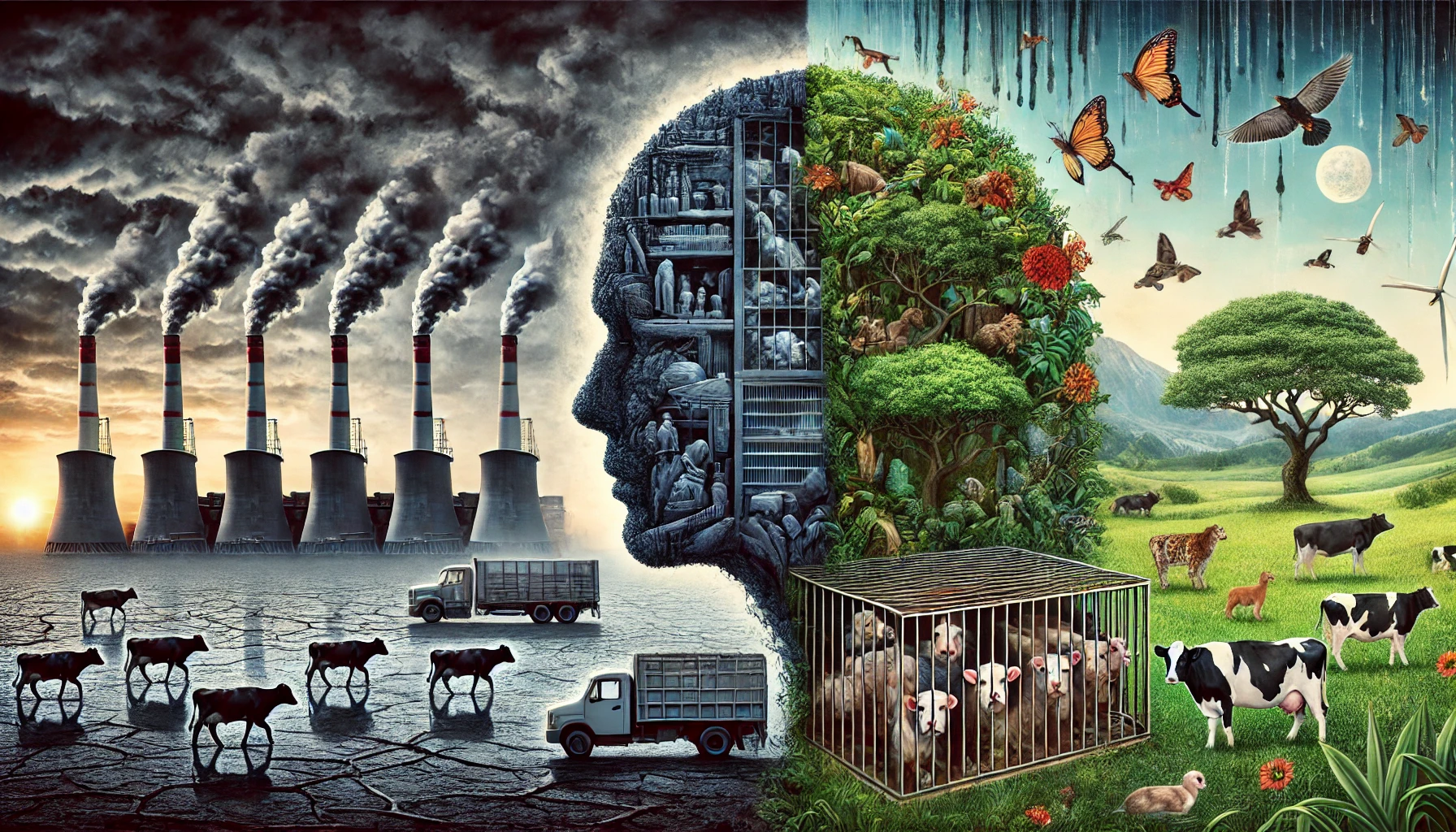
While learning about my new diet, I stumbled upon information about animal agriculture. What I learned shocked and horrified me. The extent of the needless suffering endured by billions of nonhuman animals and the environmental devastation caused by the industry was almost incomprehensible. When I learned about the horrors of the dairy and egg industries, I stopped consuming all animal products.
But what disturbed me perhaps even more was that nobody I talked to about what I’d learned was willing to hear about it. People’s responses were nearly always along the lines of, “Don’t tell me that—you’ll ruin my meal,” or to call me a “radical vegan hippie propagandist.” And these were my friends and family—conscientious and rational people committed to creating a more just world and who genuinely cared about nonhuman animals.
The Psychology of Violence and Nonviolence
Wanting to understand what caused people to harbor these contradictory attitudes and behaviors—what enabled the relational paradox I first observed when I killed the fish—I enrolled in a doctoral psychology program, where I focused on the psychology of violence and nonviolence. I wanted to know what enables caring people to participate in—or otherwise support—practices that harm both human and nonhuman beings. And: What could help change these behaviors?
I narrowed the focus of my research to examine a specific expression of the relational paradox: the psychosociology of eating animals. I sought to understand how people who care about the well-being of nonhuman animals nevertheless consume and even participate in killing them.
I conducted interviews and surveys and coded and analyzed responses. And what I discovered was that eating certain animals results from extensive social and psychological conditioning. This conditioning, which reflects and reinforces cognitive dissonance, is the product of what I came to call “carnism”: the invisible belief system, or ideology, that conditions people to eat certain animals.
Carnism causes rational and empathic people to have distorted perceptions and to disconnect from their empathy so that they act against their values of justice and compassion without fully realizing what they’re doing. In other words, carnism teaches us to violate the Golden Rule without knowing or caring that we’re doing so.
My research led me not only to the discovery of carnism but also to an understanding of how all violent or oppressive ideologies are structured. I deconstructed the carnistic system, identifying and articulating the specific social and psychological defense mechanisms that keep it intact. I also realized that these exact mechanisms exist in all oppressive systems. In other words, the same psychological (and social) mechanisms that enable us to harm nonhumans also enable us to harm humans.
If It’s Not One “Ism,” It’s Another
Humans have a remarkable ability to compartmentalize. Just as my attempts to raise awareness of carnism were met with resistance from my socially progressive, nonvegan family and friends, I found that my attempts to raise awareness of patriarchy, racism, and other oppressive systems not involving nonhuman animals caused some vegans to react defensively.
I’d point out that although women made up about 80 percent of the vegan movement, most of its leaders were men. I’d also note that vegan outreach didn’t always reflect the experiences and needs of Black, Indigenous people, and People of Color (BIPOC)—something BIPOC vegans had been saying for some time.
My comments were largely disregarded and sometimes blatantly challenged—by people who admittedly had little to no literacy, or awareness, around the issues I was raising. My experiences discussing social justice with vegan advocates paralleled my experiences discussing veganism with social justice advocates. It became clear that people would often step outside of one problematic “ism” only to land (or rather, remain) in others while believing they’d somehow extricated themselves from all such “isms.”
And this same phenomenon occurs across all relational dimensions. There are three primary dimensions in which people relate: the collective or societal dimension (how social groups relate), the interpersonal dimension (how two or several individuals relate), and the intrapersonal dimension (how one relates to oneself). People assume that awareness and transformation in one dimension automatically lead to understanding and transformation in all three dimensions.
Yet, people often step out of oppressive or abusive (unjust) dynamics or interactions in one dimension only to stay stuck in such dynamics in other dimensions. For example, people actively working toward more just social policies may be verbally abusive to those they disagree with, engaging in the same kinds of behaviors in the interpersonal dimension that they’re challenging in the societal one.
The Common Denominator
My research led me to recognize a fundamental commonality driving all forms of injustice, all forms of oppression and abuse. (Injustice—which is, by definition, unfairness or unfair treatment—is manifested most commonly and problematically through oppression and, to a lesser extent, through abuse.)
When we look at various expressions of injustice in our world, and also in our personal lives, such as war, poverty, racism, patriarchy, animal exploitation, climate change, and domestic abuse, we can see that they all share a common denominator, which is relational dysfunction, or dysfunctional ways of relating—between social groups, to other individuals, to other animals and the environment, and even to ourselves (we’re always relating to ourselves through, for example, the choices we make that impact our future self and through our “self-talk,” or internal dialogue). What this means is that a common denominator in ending these injustices, in transforming all these problems, is the opposite: relational function, or healthy ways of relating.
The Formula for Healthy Relating
Healthy relating is based on a simple formula. This formula applies to all three relational dimensions—the collective/societal, interpersonal, and intrapersonal—and to all kinds of relationships. It also applies to how we relate to nonhuman animals and the environment.
The formula applies equally to brief interactions and long-term relationships; a relationship is, after all, a series of interactions. And, of course, it applies to how we communicate since communication is the primary way we relate.
In a healthy relationship or interaction, we practice integrity and honor dignity. This leads to a sense of security and connection.
Integrity aligns our core moral values of compassion and justice with our behaviors. We practice integrity when we act according to these values. When we practice integrity, we treat others with respect; we treat them the way we would want to be treated if we were in their position.
Dignity is our sense of inherent worth. When we honor someone’s dignity, we perceive and treat them as no less worthy of being treated with respect than anyone else.
Healthy relating, like most things in life, is not an either/or phenomenon. It exists on a spectrum. Rarely is an interaction or relationship fully healthy or dysfunctional. Instead, it’s more or less so. On the healthy side of the spectrum are relational attitudes and behaviors. On the dysfunctional side are nonrelational attitudes and behaviors. Nonrelational attitudes and behaviors violate integrity, harm dignity, and lead to disconnection and insecurity (and, often, unjust power imbalances).
Consider your own experience. Think of a relationship in your life that you consider healthy. Chances are, you trust that the other person will treat you with respect, and you feel that they see you as no less worthy of being treated in such a way than anyone else. So you feel secure and connected with them. Now think of a relationship in your life that’s not healthy—maybe it’s with someone you haven’t even met in person, such as an online troll. Chances are you don’t feel that they see you as worthy of being treated with respect, and you feel insecure and disconnected from them.
If we hope to end all injustices, we need nothing short of a foundational shift in how we think about this issue. If we don’t make this shift, any attempt to bring about a more just and compassionate world will likely be futile. It’s not enough to address only who is oppressing or abusing whom. We need to understand the psychology underlying how and why we oppress and abuse in the first place. Otherwise, our efforts can lead us to trade one form of injustice for another. To end injustice, we need to change the way we relate.
When we recognize that all injustices share a nonrelational common denominator, we can better target the roots of the problem, and our justice movements can become more unified and impactful. We can appreciate that whatever our specific mission (to achieve justice for humans, nonhuman animals, or the environment), our ultimate, collective mission is to create a more relational world.
AUTHOR BIO: Melanie Joy, PhD, is a psychologist specializing in the psychology of oppression, social transformation, and relationships. She is a longtime advocate for justice and was a lecturer at the University of Massachusetts, Boston, for 11 years, where she taught courses on privilege and oppression, feminist psychology, psychological trauma, and animal rights. Joy is the award-winning author of seven books, including the bestselling Why We Love Dogs, Eat Pigs, and Wear Cows and Getting Relationships Right. She received the Ahimsa Award for her work on global nonviolence. Joy is the founding president of the charitable organization Beyond Carnism. She is a contributor to the Observatory.
This is an adapted excerpt from How to End Injustice Everywhere: Understanding the Common Denominator Driving All Injustices, to Create a Better World for Humans, Animals, and the Planet © 2023 Lantern Publishing & Media. It is licensed under Creative Commons Attribution-NonCommercial-ShareAlike 4.0 International License (CC BY-NC-ND 4.0) by permission of Lantern Publishing & Media, Woodstock, New York. Earth | Food | Life, a project of the Independent Media Institute, adapted and produced this excerpt for the web.