


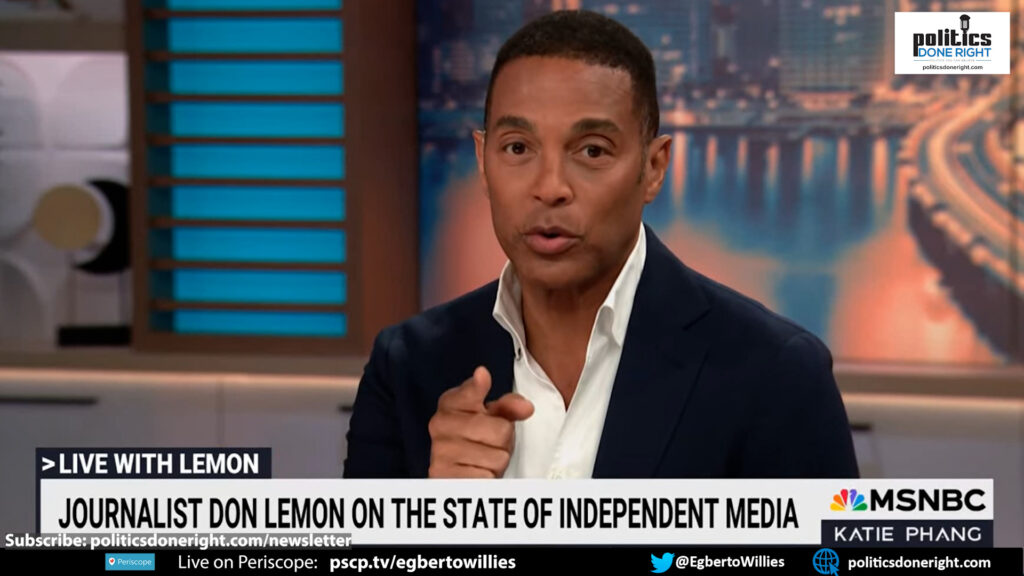
Former CNN Host Don Lemon did not mince his words about the corporate overlords in the mainstream media promoting political false equivalencies and the need for support for independent media.
Don Lemon scolds corporate media.


Podcasts (Video — Audio)
Summary of Video
In an interview with Katie Fang, Don Lemon criticized the corporate media for compromising journalistic integrity under the influence of corporate overlords. He emphasized the erosion of the traditional separation between newsrooms and business interests, leading to biased reporting and false equivalencies. Lemon highlighted the unique role of independent media in providing unfiltered truth and urged public support for such platforms to counterbalance corporate media’s waning credibility.
Key Points
- Corporate Influence: Lemon condemned corporate media for prioritizing profits over journalistic integrity.
- False Equivalency: He called out the harmful practice of balancing opposing views even when one side is objectively flawed.
- Independent Media Strengths: Lemon highlighted the freedom of independent media to deliver unadulterated truth without corporate restrictions.
- Challenges for Independent Media: Limited resources and advertiser hesitancy were noted as barriers to growth.
- Public Responsibility: The video urges supporting independent media financially and amplifying their content.
Progressive Perspective
Lemon’s critique of corporate media underscores the urgent need for a journalism landscape free from corporate interests. Independent media is a critical tool for amplifying marginalized voices, holding power accountable, and championing progressive ideals of equity and justice. Supporting these platforms is essential for fostering a well-informed citizenry capable of driving systemic change.
VP Kamala Harris outraised Donald Trump by nearly 5 to 1. Most of those monies went to poorly leveraged corporate media and entities. Imagine if instead of giving that much money to campaigns, they were giving to progressive groups to independent media. They are closer to the people and could reach more people. The people who stayed home may have been triggered by those closest to them to vote. We must not make that mistake again.
Independent media is essential to delivering the unfiltered truths that empower citizens and sustain democracy. The public can ensure that journalism fulfills its highest purpose: serving as a watchdog for the people, unencumbered by the interests of the powerful.
[ppp_patron_only level=2]
In a compelling critique of the corporate media landscape, Don Lemon, a former CNN host, used MSNBC, a corporate platform, during an interview with Katie Fang to spotlight corporate ownership’s constraints on journalism. His comments underscored the growing importance of independent media as a critical avenue for truth-telling, particularly in an era of political and social polarization. Lemon’s analysis offers a pointed challenge to mainstream media and a rallying cry for the public to embrace and support independent journalism.
Lemon’s Critique of Corporate Media
Lemon’s discussion highlights the deep-seated issues within corporate media, where profit motives often overshadow journalistic integrity. He highlighted the erosion of the traditional wall between newsrooms and corporate leadership, a division that historically protected journalists from commercial pressures. Without this separation, journalists frequently self-censor, fearing reprisals from advertisers or corporate executives. This dynamic undermines the ability to deliver unvarnished truths to the public.
Lemon specifically addressed the phenomenon of false equivalency, which has become pervasive in corporate media. False equivalency occurs when journalists present opposing viewpoints as equally valid, even when one side is demonstrably flawed or harmful. This approach, Lemon argued, is a disservice to the public, particularly in covering figures like Donald Trump, whose rhetoric and policies often challenge democratic norms.
The issue of false balance is not new, but it has been exacerbated by the corporate media’s reluctance to alienate segments of their audience or advertisers. Lemon’s candor in naming this issue is rare among high-profile journalists tied to major networks, making his critique even more significant.
Independent Media as a Beacon of Truth
In contrast to corporate media, Lemon championed independent media for its ability to operate without the constraints of corporate overlords. Independent journalists and platforms can pursue stories and analyses without fear of financial repercussions or editorial interference. This freedom allows them to provide unfiltered, nuanced reporting that serves the public interest better.
However, the video host acknowledged the challenges faced by independent media, including limited resources and smaller audiences. Advertisers often shy away from supporting politically charged or investigative journalism, further hampering the sustainability of these platforms. Nevertheless, Lemon emphasized the critical role independent media plays in fostering informed citizenry, particularly as mainstream media grapples with its waning influence and internal conflicts.
Katie Phang and the Role of Journalistic Integrity
Katie Phang, a corporate media journalist, affirmed her commitment to truth and evidence-based reporting, offering a glimmer of hope for the industry. Phang’s remarks about maintaining an ethical “true north” reflect the efforts of journalists striving to navigate corporate pressures while adhering to their professional standards. This dual commitment to corporate and independent media underscores the importance of collaboration between these spheres to advance the public good.
A Call to Action
Lemon’s appeal to viewers to support independent media is a timely and necessary call to action. As corporate media consolidates and faces increasing scrutiny, the survival of independent journalism hinges on public engagement and financial backing. Platforms like Lemon’s and Phang’s serve as critical counterbalances to the narrative control exerted by large media conglomerates.
Viewers can take tangible steps to bolster independent media, including subscribing to independent news platforms, sharing their content, and engaging with their work on social media. Financial support, through donations or memberships, is also crucial for sustaining these platforms. As Lemon noted, independent media provides an “unadulterated truth” that challenges the sanitized, profit-driven narratives often found in mainstream outlets.
The Progressive Implications
For progressives, Lemon’s message resonates deeply. Independent media has long been a cornerstone of progressive movements, offering a space to challenge entrenched power structures and advocate for transformative change. Independent journalism aligns with the progressive ethos of equity and justice by amplifying diverse voices and prioritizing accountability.
In an age of misinformation and political manipulation, supporting independent media is not just a moral imperative but a strategic necessity. It empowers communities with the knowledge needed to mobilize for systemic change, holding power to account in ways corporate media often cannot or will not.
Conclusion
Don Lemon’s critique of corporate media and endorsement of independent journalism underscores the critical need for a vibrant, independent press. By addressing the systemic challenges within corporate newsrooms and advocating for independent media, we provide a roadmap for journalists and consumers to navigate an increasingly complex media landscape. Our call to action challenges all stakeholders—journalists, consumers, and platforms—to prioritize truth over profit and democracy over corporate interests.
[/ppp_patron_only]